Gregg Shienbaum Fine Art is deeply saddened
to hear of the passing of
Pop artist pioneer James Rosenquist, at 83 years old.


Gregg Shienbaum Fine Art is deeply saddened
to hear of the passing of
Pop artist pioneer James Rosenquist, at 83 years old.
 |
||
|
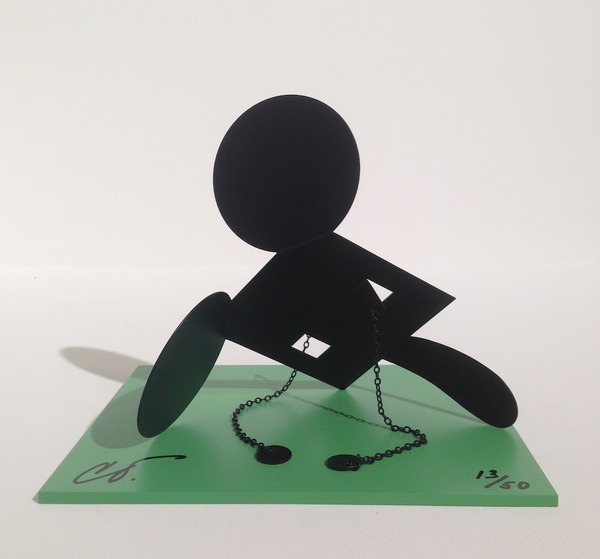
Claes Oldenburg About This Work: Claes Oldenburg is an American sculptor, best known for his public art installations typically featuring very large replicas of everyday objects. Many of Oldenburg’s works depict ‘mundane’ objects and, at first, they were ridiculed before being accepted by the art world – but they were also defined “brilliant”, due to the reaction that the pop artist brought to a ‘tired’ abstract expressionist period. The purpose of Oldenburg’s art is to uncover the mystery and power of commonplace objects by morphing their scale, shape, and texture, embracing what he calls “the poetry of everywhere”. As source of inspiration, the artist always uses things made and utilized by human beings. Used, out-of-date or simply banal, they look rescued from oblivion by the artist. While recreating objects, Oldenburg alters their specifics, transforming them through changes in material, scale, context and exaggerations of forms that lend them more than one identity. This week’s Work Of the Week, Geometric Mouse Scale E “Desktop”, is a great example of Oldenburg’s personal way of making art. As in Oldenburg’s other artworks, this image blends high and low art, but is more personal. The artist has even suggested that the Geometric Mouse is his alter ego, stating that he first took the subject of the mouse from one of the most iconic and popular characters ever: Mickey Mouse. The mouse is an extremely recurring subject in Oldenburg’s body of work. It is considered his artistic symbol par excellence, for his typical humor and use of obsolete objects and iconic characters as main source. The concept/name of the mouse ‘desktop‘ also plays on the concept of fast paced movement toward technology in today’s world, but is a nod to the past of how fast the world is actually moving. The Desktop Mouse can also be seen by today’s generation as a play on a computerized mouse on the old style green mouse pads. A mouse on a mouse pad. By deforming and decontextualizing the object, Claes Oldenburg helps it to become estranged, so that we are finally able to look at it in a different perspective: as a work of art. This happens because the artist believes that this object possesses a certain aesthetic quality, stemming from its appearance, and therefore displays it for the appreciation of others. Oldenburg has said himself that “If I didn’t think what I was doing had something to do with enlarging the boundaries of art, I wouldn’t go on doing it“.
To watch the video of Claes Oldenburg explaining the Geometric Mouse, click on the image below:
|
 |
||
|
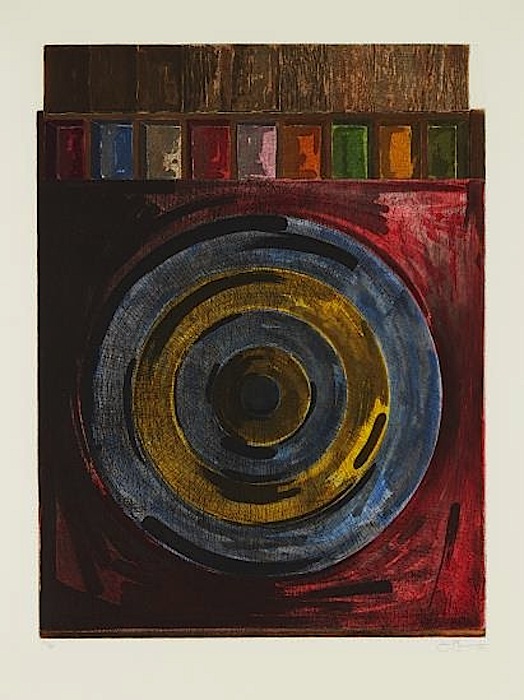
Jasper Johns About This Work: Jasper Johns is one of the most acclaimed and influential American artists of the 20th century. Born and raised in Augusta, Georgia, Jasper Johns grew up wanting to be an artist. He studied briefly at the University of South Carolina before moving to New York in the early Fifties. After a visit to Philadelphia, with his good friend Robert Rauschenberg, to see Marcel Duchamp’s painting, The Large Glass (1915-23), Johns became very interested in his work. Duchamp had revolutionized the art world with his “readymades” — a series of found objects presented as finished works of art. This irreverence for the fixed attitudes toward what could be considered art was a substantial influence for Johns. Johns’ richly worked paintings of maps, flags, and targets in the late 1950’s, led the artistic community away from Abstract Expressionism toward a new emphasis on the concrete. Johns laid the groundwork for both Pop Art and Minimalism. Today, his prints and paintings set record prices at auction. In 1958, gallery owner Leo Castelli visited Rauschenberg’s studio and saw Johns’ work for the first time. Castelli was so impressed with the 28-year-old painter’s ability and inventiveness that he offered him a show on the spot. At that first exhibition, the Museum of Modern Art purchased three pieces, making it clear that Johns was to become a major force in the art world. This weeks Work Of the Week is Jasper Johns’ Target With Plaster Casts. Targets by Johns, feature a depiction of an actual target that is, for all practical purposes, utterly interchangeable with the real thing. However, unlike the flag or the numbers, which are also familiar images from this period of the artist’s career, the flat target is simultaneously representational and abstract (a number or a flag can never be divorced from its status as a familiar sign). This makes the target susceptible to even more ambiguities. The target allowed Johns to explore a familiar two-dimensional object, with its simple internal geometric structure and a complex symbolic meaning. He was attracted to painting “things the mind already knows“, and claimed that using a familiar object like the target freed himself from the need to create a new design and allowed him to focus on the execution of the painting. Johns worked on this target with a sort of deadpan irony to test what one expects a work of art to do. A painted target automatically negates the use of a real one, and its use is lost. It stops being a sign and becomes an image, where the center is not more important than the other circles that form it. Meanwhile, the “plaster casts” on the top part of the artwork represent bits of the human body (foot, nose, face, hand, ear, penis, heart, breast, and lungs) set in their boxes. They are transformed in exactly the opposite way. Their anonymity makes them like fossils or even more, like words, signs that stand for classes of things. One would like to see them as elements of a portrait, but they cannot be read in that way. They are images turning into signs. And so, in Target With Plaster Casts, two systems of seeing are locked in perfect mutual opposition, the sign becoming a painting and sculpture becoming a sign. These kind of works by Jasper Johns were extremely new to the museum goers and art lovers, especially at a time in which the art world was searching for new ideas. Over the past fifty years Johns has created a body of rich and complex work. His rigorous attention to the themes of popular imagery and abstraction has set the standards for American art. Constantly challenging the technical possibilities of printmaking, painting and sculpture, Johns laid the groundwork for a wide range of experimental artists. Today, he remains at the forefront of American art, with work represented in nearly every major museum collection. |
 |
||
|
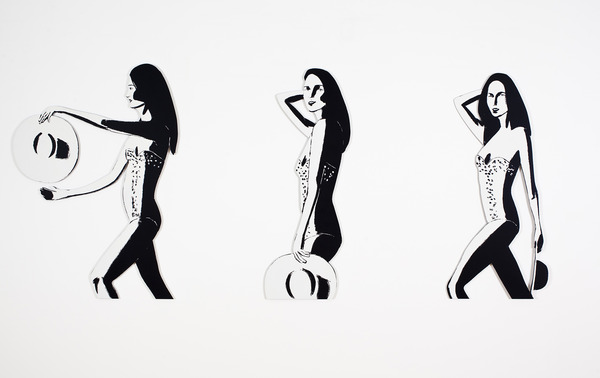
Alex Katz About This Work: Alex Katz is an American painter of portraits and landscapes. He started working on these themes during years dominated by non-figurative art, which he always strongly avoided. As for his portraits, the people he depicts are colleagues that surrounded him during his career, members of his family, friends or neighbors. Alex Katz’s portraits are always very recognizable. They are all characterized by an unmistakable flatness and lack of detail. Color and light play a central role in his works and the design of his pictorial reality always appears with sharp, clear edges. Well known for his many portraits of his wife and muse, Ada, Katz has also dedicated himself to printmaking and freestanding sculptures of cutout figures painted on wood or aluminum. This is the case of this week’s Work Of the Week, Ariel. Ariel is a three piece aluminum cut out set, created after a painting and a screenprint that he did in 2016 of the same name, that depicts a woman in three different perspectives in a sequence. This idea, the theme of variation, is very important to the artist. According to Katz, he was the first artist to start using the technique of repetition in his works, before the other artists of the time. He even says that Warhol took this concept from him. His studies on repetition start with a work called Ada Ada, which is one of his earliest work, and continue until today with this week’s Work Of the Week, Ariel. One can see how Katz’s highly graphic depiction of his subjects adds a strong sense of individualized personality to his paintings, and his attention to details, particularly when it comes to fashion, firmly characterizes the work in his own unique aesthetic. Alex Katz’ works convey a surprisingly seductive detachment from his emotions and personal references. For example, Ariel is a recurring subject in his most recent works. But who is Ariel? Is she someone relevant to the artist or is she only a model? The answer, in the end, is not important. These portraits do not own a clear narrative – it is not important for the viewer to know the person or the story behind the artwork. What Katz tries to emphasize is actually the beauty of the subjects. The use of gentle colors, the emphasis of fashion details in his paintings turn the coldness of the sharp lines, lack of detail and flatness into an artwork warm for the viewer to enjoy. In many ways, both conceptually and technically, the art of Alex Katz can be considered to be the bridge that gaps the traditions of abstraction and figurative art. |
 |
||
|
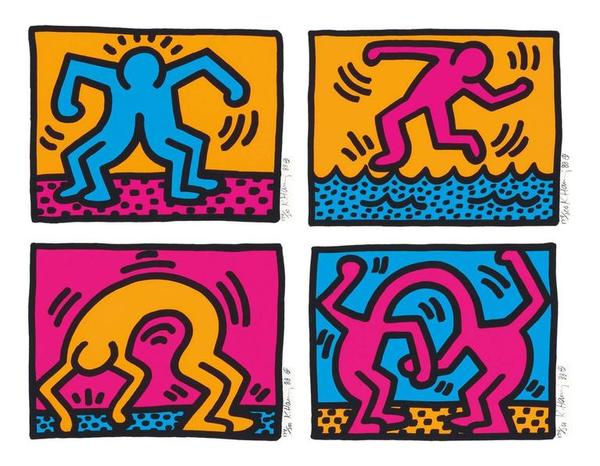
Keith Haring This must be sold as a set of 4 only. About This Work: Keith Haring was born on May 4, 1958 in Reading, Pennsylvania. He started developing a love for drawing at a very early age, learning basic cartooning skills from his father and from the popular culture around him, such as Dr. Seuss and Walt Disney. Though many associate the artist Keith Haring with his seemingly innocuous images of barking dogs, crawling babies, beating hearts and flying saucers, his work often tackled social justice issues – from nuclear proliferation, to AIDS, to the environment to racial and income inequality. In April 1986, Haring opened his first Pop Shop, a retail store in Soho selling T-shirts, toys, posters, buttons and magnets bearing his images. Pop Shop prints were released as a set of four individual pieces or one quad of the different images. While his human figures generally depict people and players in society, human figures depicted upside-down, like the one in Pop Shop II, are usually B-boys and B-girls, the dancers of hip-hop, doing the iconic move in which they spin on their head. Figures contorting in backbends or jumps are also depictions of break dancers, some of the most iconic cultural figures of the New York City of the 1980’s. In the Pop Shops, Keith Haring always kept imagery accessible and easy to understand, in order to grab the eyes and minds of viewers and get them both to enjoy themselves and to engage with important concerns. |
 |
||
|
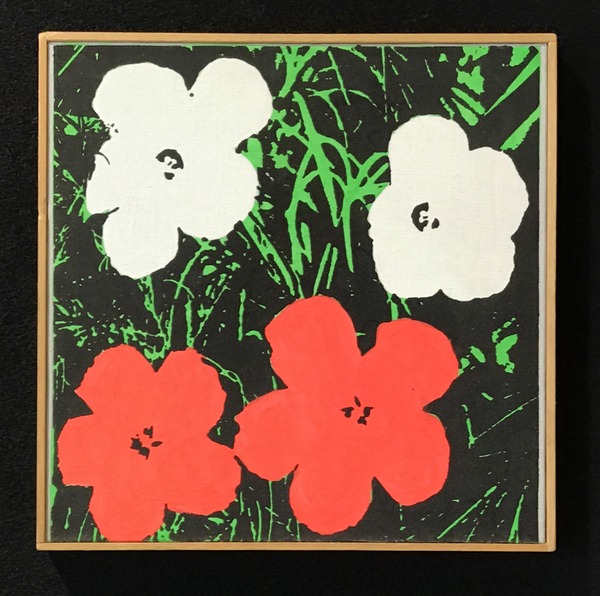
Richard Pettibone About This Work: Richard Pettibone is one of the pioneers of appropriation art. The artist helped set the stage for 80’s appropriation art by recycling the pop culture appropriations of Pop Art. Creating small ‘pocket size’ paintings from Pop Art images already made famous, Richard Pettibone does artwork that is described as “cloning”, which has resulted in art that he can call his own. It all started in 1964. When he was 26 and living in Los Angeles, he produced two tiny, exquisitely made copies of Andy Warhol’s 1962 painting Campbell Soup (Pepper Pot), one in green, the other in gray, both stamped with Warhol’s name and his own. Marcel Duchamp, along with Andy Warhol, were of significant influence. Between 2005-2006 the artist had a retrospective of approximately 200 paintings and sculptures at the Laguna Art Museum, Laguna Beach, California and The Frances Young Tang Teaching Museum and Art Gallery at Skidmore College, Saratoga Springs. |
 |
||
|
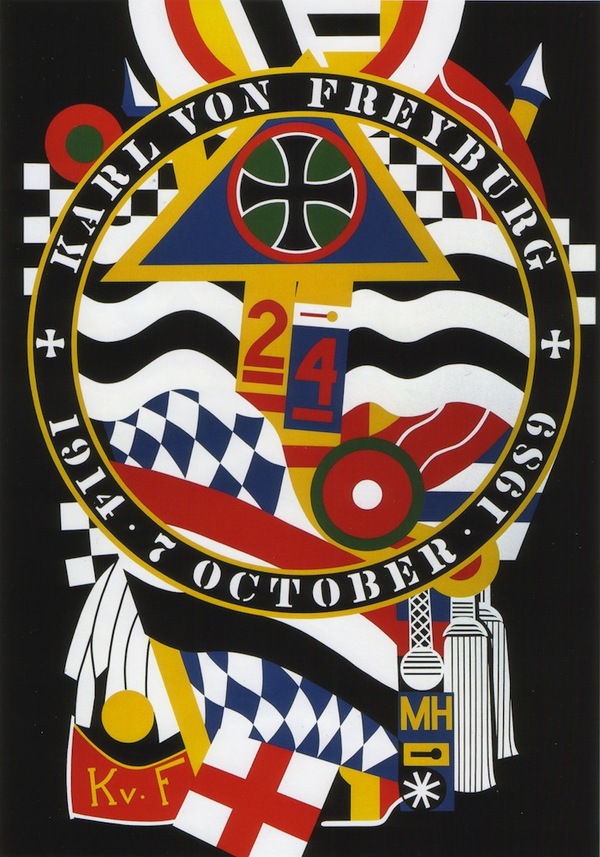
Robert Indiana About This Work: Born Robert Clark in New Castle, Indiana, in 1928, Robert Indiana adopted the name of his native state as a pseudonymous surname early in his career. Robert Indiana is one of the six original pop artists. However, what distinguishes Indiana from his “Pop” colleagues is the depth of his personal engagement with his subject matter. Indiana’s works all speak to the vital forces that have shaped American culture in the late half of the 20th century: personal and national identity, political and social issues, the rise of consumer culture, and the pressures of history. Rather than using symbols from the mass media, Indiana makes images of words that focus on identity, enticing his viewers to look at the commonplace from a new perspective. This work of the week, KVF I, is the first one of a series of 10 prints called Hartley’s Elegies. The series was inspired by Mardsen Hartley’s painting Portrait Of A German Soldier, that is exhibited in the permanent collection of the Metropolitan Museum Of Art, in New York City. Hartley was an American painter who executed this painting as a tribute to the young German soldier Karl Von Freyburg, who died during World War I and with whom Hartley had a deep friendship/relationship. This is Indiana’s personal reinterpretation of Hartley’s painting. Indiana’s Elegies not only retell Hartley’s story but also provide us with a glimpse of his own story, with allusions to himself, his peers, places and historical events with overlapping symbolic meanings, forming a web linking his life to Hartley’s life. There is even a guide to decode Indiana’s Elegies. For example, “7 October 1989” is the date in which Indiana began the Elegies series, 75 years after Von Freyburg’s death; it is also the year of the fall of the Berlin Wall. Another very interesting fact is that in the other prints of the series one can see the recurring word “Ellsworth”. Ellsworth is the town in Maine where Hartley died, but it is also a reference to Ellsworth Kelly, the famous artist and influential former partner of Indiana in New York. KVF I is the most similar to the original painting of the series, keeping the original image, colors and theme. It is not a reinterpretation of Hartley’s painting, as the other prints of the series are. Robert Indiana’s Hartley’s Elegies series is very complex, introspective, intellectual and cerebral. The beauty of Indiana’s work is indeed the beauty of taking one’s time to quietly look at something that is not new, but just part of someone’s daily life. It is the beauty of balance and harmony, contemplation and knowledge, the beauty of pure reflections translated in conceptual images. Indiana captures the complexity of Life in the enigmatic intricacies of his compositions. He is a Pop artist but, from this particular point of view, he can also be considered fully conceptual for his hermetic style, which represents an evident break from the “lack of message and superficiality” of the Pop Art movement.
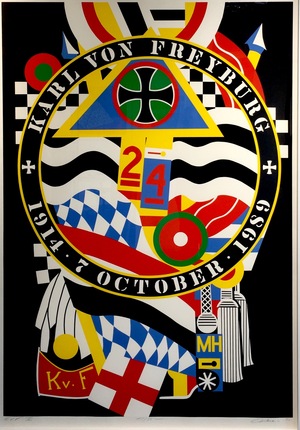 KVF I by Robert Indiana 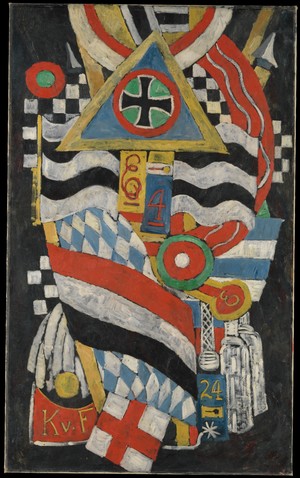 Portrait Of A German Soldier, by Marsden Hartley
|
 |
||
|
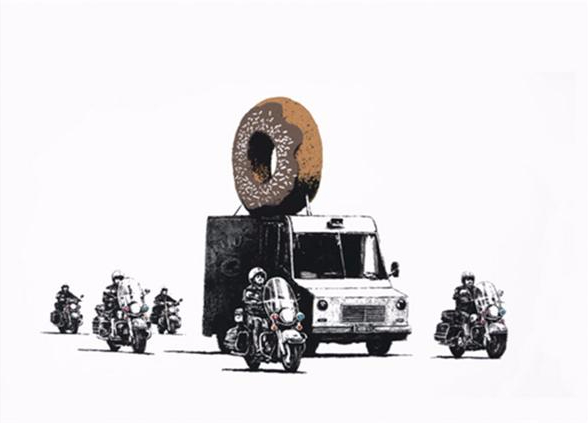
Banksy About This Work: Banksy is a British street artist and activist who, despite worldwide fame, has maintained anonymity. Although details of the artist’s life are largely unknown, it is thought that Banksy was born in Bristol more or less around 1974, and started his career in this city as a graffiti artist. His satirical street art and subversive epigrams combine dark humor with graffiti executed in a very personal and distinctive stenciling technique. Banksy’s work features striking and humorous images, occasionally combined with slogans. The message is usually anti-war, anti-capitalist or anti-establishment. Subjects often include rats, apes, policemen, soldiers, children, and the elderly. This work, Donut (Chocolate), needs no explanation. It is simply a spoof on the stereotype that American policemen are infatuated with donuts. In 2014, Banksy was regarded as a British cultural icon, with young adults from abroad naming the artist among a group of people that they most associated with UK culture, which included William Shakespeare, Queen Elizabeth II, David Beckham, The Beatles, and Elton John. His works of political and social commentary have been featured on streets, walls, and bridges of cities throughout the world. As of today, his work can be found in countless cities, from Vienna to San Francisco, Barcelona to Paris and Detroit. |
 |
||
|
Alex Katz About This Work: Alex Katz is an American painter of portraits and landscapes. He started working on these themes during years dominated by non-figurative art, which he always strongly avoided. He is mostly known for his portraits: the people he depicts are colleagues that surrounded him during his career, members of his family, friends or neighbors. These portraits do not own a clear narrative – it is not important for the viewer to know the story behind the artwork. What Katz tries to emphasize is actually the beauty of the subjects. The use of gentle colors and the emphasis of a few but significant details turn the coldness of the sharp lines, lack of detail and flatness into an artwork warm for the viewer to enjoy. The genius of Alex Katz’s style is derived directly from one of Katz’s biggest influences, the Master Japanese woodblock artist Kitagawa Utamaro (1753 – 1806), the master of Japanese woodblock color printing. His Japanese aesthetic is typically flat and bi-dimensional. He influenced Katz particularly with his use of partial views and his emphasis on light and shade. This work, Dog At Duck Trap, it is slightly different from Katz’s portraits. This time, the subject is not a person but an animal. Sunny is portrayed in a surrounding that is nothing but the coasts of the Duck Trap, a river located in Waldo County, Maine, where Katz still spends his summers. Alex Katz’s works can be found in over 100 public collections worldwide. Major exhibitions of Katz’s landscape and portrait painting in America and Europe followed his 1986 Whitney Museum of American Art retrospective and 1988 print retrospective at the Brooklyn Museum of Art. |
 |
||
|
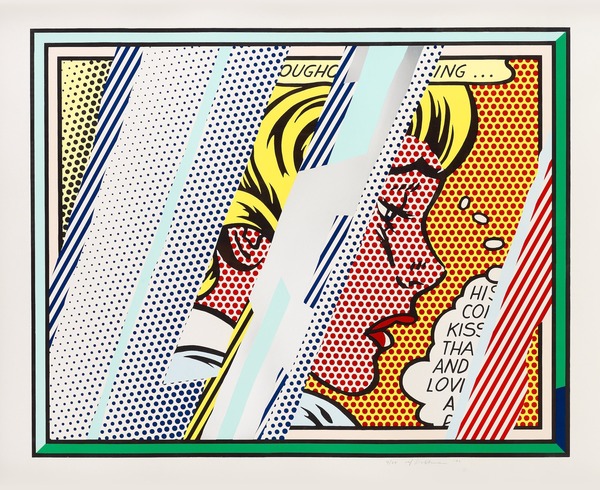
Roy Lichtenstein About This Work: Pop art legend Roy Lichtenstein, born in Manhattan in October of 1923, began his studies in New York but finished at Ohio State University and thereafter began teaching at different universities, a profession he continued until 1964. He became known for his bold colors, thick lines, and use of comic strips to influence his work. His very personal and unique style derived from comic strips which portray the trivialization of culture, endemic in contemporary American life. Using bright, strident colors and techniques borrowed from the printing industry, he ironically incorporates mass-produced emotions and objects into references to popular icons and art history. Lichtenstein has often explored the theme of Reflections, incorporating them in various paintings and several print series. In 1988 Lichtenstein began working on a group of Reflections paintings, in which the central image is partly obscured by reflective streaks, as if behind glass or reflected in a mirror. This week’s work of the week, Reflections On Girl, is considered to be an iconic work. It is a perfect example of Lichtenstein’s style. A style made of primary colors – red, yellow and blue, heavily outlined in black. Instead of shades of color, he used the ben-day dot, a method by which an image is created, and its density of tone modulated, through the position and size of a myriad of dots during the printing process. Lichtenstein used an image he found in an edition of the comic book Falling In Love as the basis for the female figure in this image. Lichtenstein seems to create an intentionally stylized and stereotypical image of a 1960’s beauty. In the original cartoon, text above the image read: ‘Fire seethed through my body … fanning … spreading’, while the girl’s thought-bubble reads, ‘H-He couldn’t kiss me that way and love someone else!‘. Reflections On Girl is a very important print from a very important series by Lichtenstein. It has everything that one would want in a Lichtenstein work. The lines, the benday dots, the bright colors, the cartoonish girl figure, and the bubble letters. |