 |
||
|
MARILYN MINTER About This Work: Marilyn Minter (born in 1948) is an American contemporary photographer/artist. Marilyn Minter has been a part of the New York art scene since the late 1970s. Her artistic career started with a series of now celebrated photographic studies of her drug-addicted mother while she was still a student in Florida. Starting from the 1990s, she started to gradually refine her style and imagery so that, while still suggesting some kind of sexual undercurrent, her photographs and paintings seem equally to breathe the atmosphere of high fashion and contemporary glamour. For over three decades, Marilyn Minter has produced lush paintings, photographs, and videos that vividly manifest our culture’s complex and contradictory emotions around the feminine body and around the concept of beauty, by bringing into sharp, critical focus the power of desire. Prism is a refined version of Minter’s early works, which despite still having pornographic undertones, exudes a sense of glamour and high-fashion. Through this work, one can see how Marilyn Minter both celebrates and criticizes glamour. By depicting these sexy red lips, with shiny jewels and sparkling glitters, that reflect light, she is portraying the complexities of glamour. This work not only depicts glamour, but also what glamour “feels like”. Marilyn Minter has been the subject of numerous solo exhibitions and group exhibitions all over the worlds. In April 2015 Marilyn Minter opened her first major retrospective in the Museum of Contemporary Art Houston. This exhibition contains works that Minter had developed from 1976 to 2013. Perfectly suited, the exhibit was titled Pretty/Dirty. |
Tag Archives: modernart
WOW – Work Of the Week – John Baldessari “Person On Horse And Person Falling From Horse (With Audience)”
%20stock.jpg "Intersection Series (Person On Horse Person Falling From Horse with Audience) stock") |
||
|
JOHN BALDESSARI About This Work: Known as the Godfather of Conceptual Art, John Baldessari has defied formalist categories by working in a variety of media — creating films, videotapes, prints, photographs, texts, drawings, and multiple combinations of these. In his use of media imagery, Baldessari is a pioneer “image appropriator”, and as such has had a profound impact on post-modern art production. Born on June 17, 1931 in National City, CA, John Baldessari has been instrumental in the West Coast art scene. His artwork has influenced a generation of conceptual artists like Cindy Sherman, Barbara Kruger, David Salle and many other younger artists. He may be best known as the artist that “Put dots over people’s faces”, but through his diverse practice that includes paintings, sculpture, and installations, the artist shaped the Conceptual Art landscape. By blending photography, painting, and text, Baldessari’s work examined the plastic nature of artistic media while offering commentary on our contemporary culture. What John Baldessari does, is he fuses photography, montage, painting and text to create complex compositions that explore the several interpretations of cultural iconography. He sources his wide range imagery from the larger visual world, primarily finding inspiration in advertising and film. This work, Person On Horse And Person Falling From Horse (With Audience), from the Intersection Series, is a perfect example of the manner in which Baldessari deconstructs found images of action and perception stereotypes of the mass media. This series features contrasting collaged images enclosed in rectangles and juxtaposed, each one with a different theme and title. The superposition of several image sections results in a complete “cinematic” sequence: under the eyes of two applauding spectators a cowboy falls from his horse, while the Indians remains firmly in power. In order to subvert common associations, John Baldessari brings one’s attention to minute details, absurd juxtapositions, and obscured or fragmented portions of such imagery. His artistic process focuses on the perception and interpretation of visual elements and text, while often employing irony to make playful assertions about how meanings and interpretations are formed. The Intersection Series work blends photographic materials such as these film stills, which Baldessari takes out of their original context, and rearranges their form. We have also attached a link to a video Called the “History of John Baldessari”. It is a 5 minute video narrated by muscian Tom Waits. It is very entertaining, informative, and very funny!!! Please have a look and enjoy! |
Biscayne Boyz New Music Video
*BISCAYNE BLOCK BOYZ*
NEW MUSIC VIDEO
by AHOL SNIFFS GLUE and OTTO VON SCHIRACH
—
Ahol Sniffs Glue has just released a new music video with Otto Von Schirach.
The video has been featured in the Miami New Times… Link to the full article HERE
WOW – Work Of the Week – Alexander Calder “Our Unfinished Revolution” Portfolio
 |
||
|
ALEXANDER CALDER About This Work: Alexander Calder (1898 – 1976) is one of the most celebrated artists of the 20th century. Subsequently, upon moving to Paris in 1926, Calder began creating large-scale mechanical installations of intricate circus scenes, featuring wire sculptures with moving parts that he would operate over a two-hour performance session. Building off of his so-called Cirque Calder, he began sculpting portraits and figures out of wire, and received critical attention, exhibiting these works in gallery shows in New York, Paris, and Berlin. While in Paris, he befriended several important Abstract artists, including Joan Miró and Piet Mondrian, and was invited to join the group Abstraction-Création in 1931. Many of Calder’s works on paper and his printwork are studies, tests and theories about his sculptures. As Calder’s sculptures moved into the realm of pure abstraction in the early 1930s, so did his works on paper and prints. The thin lines used to define figures in the earlier prints and drawings began delineating groups of geometric shapes, often in motion. This work from the portfolio Our Unfinished Revolution, is a two-dimensional insight into Calder’s three-dimensional world. Alexander Calder has had several retrospectives, and, among many other awards, was honored with the Presidential Medal of Freedom and the Bicentennial Artist Award from the Whitney Museum of American Art in New York City in 1976. The Guggenheim Museum showed a retrospective of his work in 1964. |
WOW – Work Of the Week – Robert Indiana “American Dream #5”
 |
||
|
ROBERT INDIANA About This Work: “Among the rain Robert Indiana is one of the original 6 American Pop artists who, back in the 1970s, literally changed the world of art. Subsequently, he moved to Vinalhaven, a place that has acquired an allure of almost mystical isolation, throughout the years. Here Indiana has retired from the world since 1978, although still actively working and producing art. In 1964, when he was still living in New York City, Indiana moved from his first place, a building called Coenties Slip, to a five-story building in the Bowery. In 1969, he began renting the upstairs of a building called “The Star of Hope”, in the island town of Vinalhaven, Maine, as a seasonal studio, from the photographer Eliot Elisofon. This place was wider and very functional for his big works. Half a century earlier, Marsden Hartley, the main source of inspiration for Indiana’s Hartley Elegies suite, had made his escape to the same island. When Elisofon died, Indiana moved in full-time. Indiana’s work often consists of bold, simple, iconic images, especially numbers and short words. His best known example is LOVE, used in countless paintings, prints and sculptures. American Dream #5 is not only referring specifically – through its title – to another painting by another major American painter, Charles Demuth, but it is also a pictorial hymn to a poem by William Carlos Williams, that inspired Demuth himself. Charles Demuth painted a work titled I Saw The Figure 5 In Gold, inspired by Williams’ poem The Great Figure. The poet, in turn, was inspired by seeing a fire truck passing down the street at full speed, with a big gold silhouette of a 5 on the background. One can clearly see the shades of gray that make stand out the other bright and strong colors. The geometrical shapes of stars and circles, and the progressive size of the figure 5, create an optical illusion of movement and speed, making the figure 5 pop and vibrate off the paper as the view stares at it. This chain of poetical and pictorial allusions is enriched in this work by a whole other chain of references to birth or death dates that form a web of intricate numerological references based on various coincidences: Demuth’s painting is dated 1928 – also the year of Indiana’s birth. Indiana’s painting is dated 1963 – also the year of Carlos Williams’ death. The succession of rows of three 5s suggests the figure 35: Demuth died in 1935. This succession of 5s is also describing the sudden progression of the firetruck in the poet’s experience. American Dream #5 itself is composed like a poem, and its cruciform shape remains Indiana’s unmistakable mark. The monosyllabic words like EAT, HUG, ERR, DIE, also belong to Indiana’s own poetry. Again, here autobiography occupies an important role as well: EAT & DIE refer to his mother’s last word before she died. American Dream #5 is Indiana’s most impressive and important work. The poetical, numerological, biographical associations embedded in this work make this jazzy though straightforward artwork one of the most complex works of Indiana’s career and in American Pop art. |
WOW – Work Of the Week – Andy Warhol “Portraits Of The Artists”
 |
||
|
ANDY WARHOL About This Work: Andy Warhol was the most successful and highly paid commercial illustrator in New York even before he began to make art destined for galleries. Neverthless, his screenprinted images of Marilyn Monroe, soup cans, and sensational newspaper stories, quickly became synonymous with Pop Art. Pop Art marked an important new stage in the breakdown between high and low art forms. Warhol’s paintings from the early 1960s were important in pioneering these developments, but it is arguable that the diverse activities of his later years were just as influential in expanding the implications of Pop Art into other spaces, and further eroding the borders between the worlds of high art and popular culture. Andy Warhol is now considered one of the most influential artists of the second half of the 20th century, who created some of the most recognizable images ever produced. Warhol was part of a very exclusive group of artists that the famous and influential New York dealer, Leo Castelli, represented. In 1967 Warhol created Portraits of the Artists, a work that depicts the portraits of 10 artists chosen and represented by Castelli. Sticking with Warhol’s signature style of repetition, he multiplied the artists’ portraits ten times in ten different colors on 3-D polystyrene boxes, each measuring at approximately 2 x 2 inches. The 100 boxes totaled to approximately 20” x 20” when lined up. The artists include Robert Morris, Jasper Johns, Roy Lichtenstein, Larry Poons, James Rosenquist, Frank Stella, Lee Bontecou, Donald Judd, Robert Rauschenberg and Andy Warhol himself. Warhol used the power of the portrait to bring forth the idea of America’s infatuation with celebrity, and the effects of the celebrity in our culture. Pop culture was not only just about Coca Cola bottles, Campbell’s Soup Cans, and Brillo boxes, but also about taking TV, film, music, or literary personalities and exploiting the concept of celebrity. What a better way to pay homage and respect to the most important artists of the time by having Andy Warhol create a work of art that said so much about the artist’s influence on our culture, with just their portraits. No words were needed. The use of repetition is also typical of Andy Warhol. Warhol used silkscreen as his medium of choice. It served as a way to remove the hand of the artist in art, a concept Marcel Duchamp introduced to the art world in the early part of the century. Warhol’s biggest influence in art was Duchamp. Repetition also allowed the artists to further their concepts, by reaching a greater amount of people. Printmaking was the best way to achieve this. By making multiples of a work, more people can own the work, sell the work, and are exposed to the work. It was this marketing that led to Andy Warhol becoming a celebrity himself. |
WOW – Work Of the Week – Jasper Johns “Two Flags”
 |
||
|
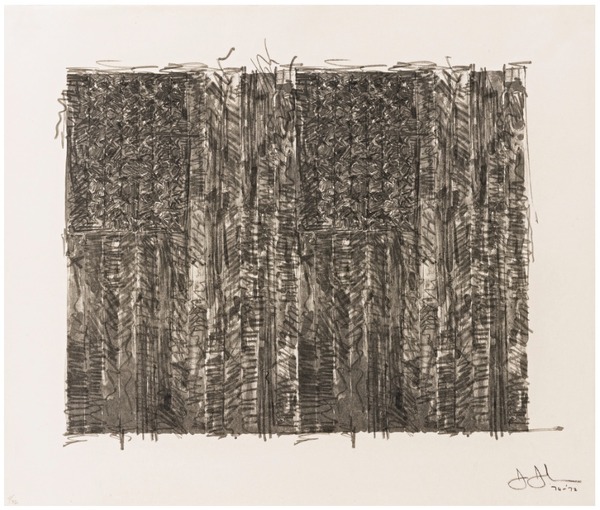
JASPER JOHNS About This Work: “Jasper Johns did not make a painting of the American flag, he made the American flag a painting” – Ron English Jasper Johns was born in 1930 in Georgia, and from an early age, he grew up wanting to be an artist. When in New York City, where he moved to in his twenties, he met the artist and future long-term lover Robert Rauschenberg, choreographer Merce Cunningham, and composer John Cage, all of whom profoundly influenced each other. His career began with a desperate act. At 24, in 1954, two years after he was discharged from the U.S. Army, he destroyed nearly all his art. Then came a kind of vision. “I dreamed I painted a large American flag”. The next morning he began doing just that. His thoughts must have been racing; the enamel house paint he was using wasn’t drying fast enough to capture them. So he switched to wax encaustic. This ancient medium, made of heated beeswax mixed with pigment, dries almost immediately, preserving and showing every brushstroke. This painting was the first of about 100 works that Johns has said were inspired by the dream of the American flag, the painting for which Johns is best known. Jasper Johns’ flag is not just an artwork; it has become one of the most important symbols in the American art. When the first flag was released, critics were unsure whether it was a painted flag or a painting of a flag; Johns later said it was both. For this reason, this work is often described as a piece of Neo-Dadaist and Conceptual art. Due to the playfully subversive appropriation and use of a commonplace icon, it also anticipates aspects of Pop Art. This print, Two Flags, represents two vertical flags and it shows how the artist used to produce flags through variations of not only palette but also position, and repetition, divorcing the flag from its symbolic meaning and focusing on the materials and on the concept.
Initially serving as a means of emphasizing the physical properties of an object by draining it of color and emotions (he often used to say that he liked “to paint with no emotions“), the artist’s employment of gray has evolved into a larger concern. Gray, black, and white exist in Johns’ work not just as colors, but also as ideas and materials. Jasper Johns, indeed, believed the process to be the most important part of making an artwork (This fact led him to experiment with countless media, such as oil, encaustic, ink, pencil, collage and relief, and a prolific career in print making). In November 2014 one of Johns’ encaustic flag paintings was auctioned off for $36,000,000 at Sotheby’s New York.
|
WOW – Work Of the Week – Alex Katz “Julia And Alexandra”
 |
||
| ALEX KATZ Julia And Alexandra 1983 Screenprint 37 x 74 in. Edition of 75 Pencil signed and numbered
About This Work: Alex Katz is an American painter of portraits and landscapes. He started working on these themes during years dominated by non-figurative art, which he always strongly avoided. Alex Katz’s portraits are always very recognizable. They are all characterized by an unmistakable flatness and lack of detail. To represent a shadow or light, he uses slight variations of colors. Many times, monochrome backgrounds represent another defining characteristic of his style. This work, Julia And Alexandra, represents a perfect example of Katz’s style. The flatness and lack of details are juxtaposed by the gradual shading of colors, creating a sense of dimensionality and a conceptual complexity. One important factor that makes his simplistic works more complex is the representation of fashion. It may seem minimal – a couple of lines for a necklace, some polka dots on a scarf – but these details of fashion are most important. As we can see, in this particular work, Julia And Alexandra, Katz not only depicts this portrait in his unique style made of monochromatic colors, flatness and lack of details, but also ties them together with this unifying element of fashion. Despite their apparent simplicity, these details make the faces extremely expressive and perfectly capture the essence of the subjects. It is this element of detail in his work that the artist has always been passionate about. His interest in fashion increased in 1960s, when he began designing sets and costumes for choreographer Paul Taylor as well as theater and dance shows. Costumes, hairstyles, glasses, clothes, shoes, scarves or bathing caps are meticulously considered, as well as the gaze of the subject and his/her position; whether sitting or standing. The genius of Alex Katz’s style is derived directly from one of Katz’s biggest influences, the Master Japanese woodblock artist Kitagawa Utamaro (1753 – 1806). Utamaro’s woodcuts are in the Ukiyo-e tradition, which means “pictures of the floating world” and represent everyday life scenes, capturing a specific person or a particular moment. Utamaro is one of the most highly regarded practitioners of the genre of woodblock prints. He is known for his portraits of beautiful women. This Japanese aesthetic is typically flat and bi-dimensional. He influenced Katz particularly with his use of partial views and his emphasis on light and shade. As with all of Katz’s works, Julia And Alexandra definitely follows along the style and influence of Utamaro’s artworks. Below are a few examples of Utamaro woodblock prints. 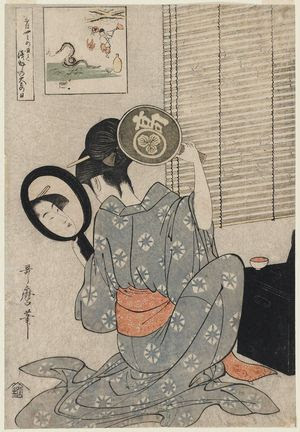 Takashima Ohisa Using Two Mirrors To Observe Her Coiffure  A Beauty After Her Bath
|
WOW – Work Of the Week – Lichtenstein “Two Figures With Teepee”
 |
||
|
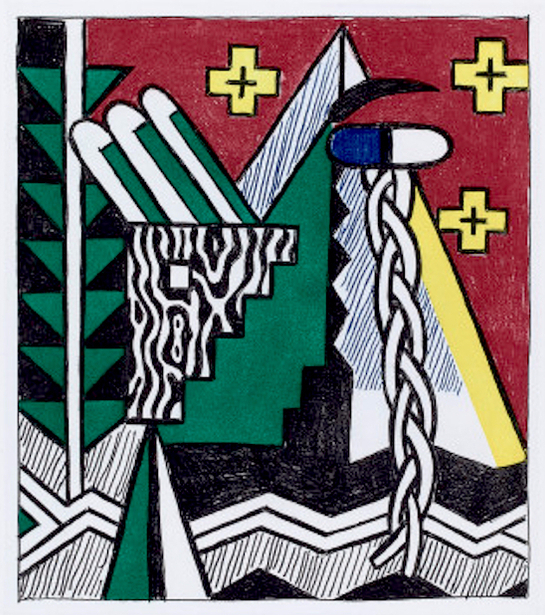
LICHTENSTEIN About This Work: When one thinks of Roy Lichtenstein, one does not think of American Indian Art. However, Lichtenstein was interested in the people of the Old West, particularly Native American Indians. Lichtenstein’s engagement with American Indian art is reflected in two periods: his earliest work and his Surrealist series of the late 1970’s-1980’s. His interest in American Indian art began during the days of his childhood in New York, during several visits to the American Museum of Natural History. In 1950, he began a series of jokey takeoffs on heroic myths and legends. His interest was also partly stimulated by his experiences in Southampton during the late 1970s when he and his wife resided near a Shinnecock Indian reservation, and by the collections of friends such as Jasper Johns, Frank Stella and Donald Judd, all of whom were known to have acquired Native American blankets and other objects to use in their work. Some of the themes that Lichtenstein used in his works are American Indian symbols, specific designs for mythical animals found on pottery and in books, and the hatched lines from Southwestern pottery, textiles and ceramics, just to name a few. Lichtenstein’s Two Figures With Teepee is part of a series of six small intaglios, all of which are soft-ground etching, aquatint and engravings about the American Indian theme. This series was accompanied by another series of six woodcuts, larger in size and different in style. This particular phase of Lichtenstein’s American Indian-inspired work occurred from 1979 to 1981, long after he had established his familiar Pop style. This work has a classic Native American palette formed by saturated reddish-brown, green, yellow and black pigments, with the mold-made Lana paper constituting the rest of the image. The tones refer to the earth and the colors that American Indians use for their textiles and handcrafted items. In Two Figures With Teepee several important elements are present, all recalling the American Indians’ lifestyle and traditions: lightning-like zigzags and crosses symbolizing the four directions, arrow-like triangles, graphic patterns that symbolize wood and leather textures, and a strong component of geometrical abstraction through which the artist reshuffled, stripped and reworked the elements in the flat planes and geometry of Synthetic Cubism. The first figure is formed by a blue eye with and eyebrow and a braid, like the long braids of the American Indian women. The second figure is formed by a squared eye – a type of eye that Lichtenstein often used for this series – and a group of feathers that resembles the typical American Indian headress, almost always decorated with feathers. Both figures make reference to the larger woodcut series. Two Figures With Teepee is formally and iconographically very interesting, a perfect example of the spatial dislocation, proper of the Cubist movement, that unifies all the elements instead of dividing them. Some critics have also stated that the powerfully graphic nature of Native American art most likely appealed to Lichtenstein due to its visual similarity to his own style at this time. Other works by this artist:  Landscape With Boats  Mirror #7  Painting On Blue And Yellow Wall |
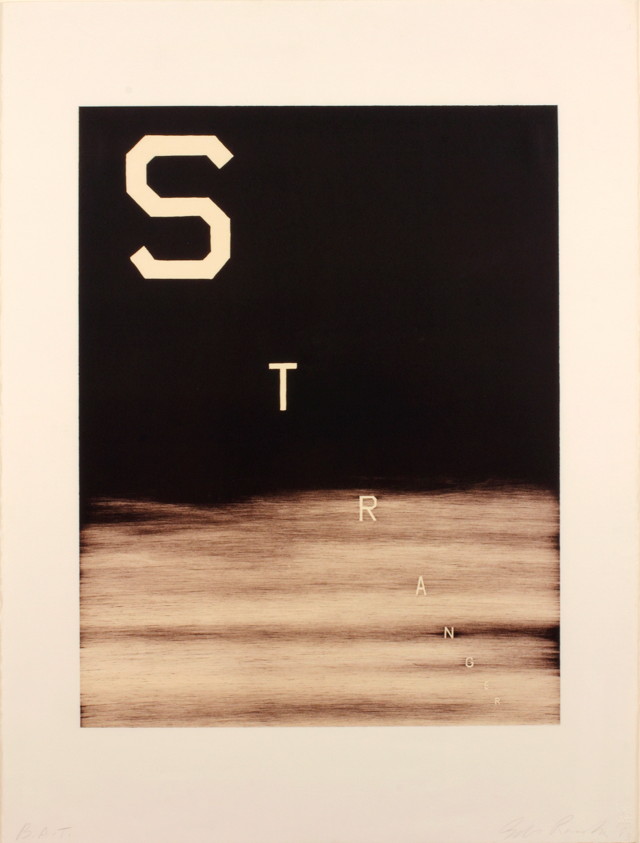
WOW – Work Of the Week – Ed Ruscha “Cash For Tools 2”
 |
||||
|
ED RUSCHA About This Work: Ed Ruscha is a well-known American artist who achieved recognition for artworks incorporating words and phrases, all influenced by the deadpan irreverence of the Pop Art movement. Indeed his textual art can be linked with the Pop Art movement but also with the Beat Generation as well. During the Cold War era, the rise of commercial advertising was a dominant force in American life. Consequently, the increasing importance of graphic design, the popularity of Hollywood and American cinema as well as the lights and the landscapes of the West Coast, provided the backdrop against which Ruscha developed his highly original iconography. Since the early sixties, Ed Ruscha has wittily explored language by channeling words and the act of communication to represent American culture. Language, in particular the written word, has pervaded the visual arts, but no other artist has the command over words as Ruscha. His works are not to be understood as pictures of words, but instead words treated as visual constructs. His idea plays into the very essence of Pop Art. Cash For Tools 2 is part of the Rusty Signs, series in which Ruscha uses words, that he considers as “neglected and forgotten signs from neglected and forgotten landscapes”. These Rusty Signs are reproduced in uncanny detail that blurs the line between the fictitious and the real. This artwork, as well as the whole series, is further expression of a consistent theme that runs throughout his work: the passage of time. We are confronted with the physical effect of time upon them, a blunt reminder of its inescapability, even on steel. Once again filtered through the language of common American objects, these prints appear to be rusted signs that read “DEAD END,” “CASH FOR TOOLS,” and “FOR SALE 17 ACRES.” Ruscha has chosen to produce multiple variations of these signs, giving the impression that they have been weathered by time in varying ways, as if they came from different locations or were subjected to a different set of circumstances. For example there are two versions of Cash For Tools and Cash For Tools 2 is more ruined and consumed than Cash For Tools 1. Some have gunshots and some are missing sections, while others appear to have acquired thick layers of rust and grime. In this way, each piece of the series seems to contain an independent story, their histories having literally formed their present state. The Rusty Signs series also marks a transformation of some of Ruscha’s aesthetic concerns; having painted and photographed signs and signage throughout his career, works such as Cash For Tools 2 signify the first time in which he is not merely representing the image of the sign, but actually recreating the sign itself. We no longer see a fictionalized representation but we actually see the sign itself, and its physicality is a part of its essence. At the same time, having been removed from context, they still share the sense of disconnection that permeates in many of his depictions of signs. Ruscha asks us to consider these components of visual culture as independent objects, as if their introduction into the world was not merely an accident or result of inevitable forces, but an act of creation, a work of art. Other works by this artist:
|
||||