WOW! – Work of the Week 6/22/15

Julian Opie, Walking in the Rain, London

Julian Opie       Walking in the Rain, London       2015

Julian Opie Walking in the Rain, London 2015

Julian Opie
Walking in the Rain, London
2015
Screenprint on Somerset Satin tub sized 410 gsm paper
59 x 86 3/8 in.
Edition of 50
This piece is signed and numbered.

About This Work:

In his newer works, like Walking in the Rain, London, we start to see more complexity in Opie’s figures when compared to his very minimal and simplistic figures of the past.  In his newest works, Walking in the Rain, London and Walking in the Rain, Seoul Opie is introducing elements of consumerism, technology and 21st century issues.

This can be seen by his use of brand names in both works. For Walking in the Rain, London he shows us a bag with Tate Museum’s logo and a Tesco shopping bag, which is a supermarket in the UK, as well as people listening to their ipods and smart phones.

While his figures are still void of facial features, Opie brings our attention to the fact that the clothes and shoes we wear, the places we patron and the gadgets we use in a way define us as individuals, as a city and as a society. This work in a sense is anthropological as it speaks to the time and the current state of how we interact and live by capturing different people going different directions and all in the same place.


About Julian Opie:

Julian Opie is a visual artist, and one of the New British Sculpture movement.

He is one of the most significant artists of his generation whose artistic preoccupation has investigated the idea of representation and the means by which images are perceived and understood. Throughout his practice, Opie has developed his own reductive formal language which seeks to reflect, not reality itself, but rather the way in which reality is represented: his distinctive language of discipline and formal consistency which is employed in his current portrait and landscape work.

He says, he sets out to strip things down, the purpose being to reflect and play on not just other art, but on the artifice that he thinks frames contemporary experience: how what is seemingly natural in human behavior is made up of learned performance codes, how artistic conventions constrain artistic practice.

In his portraiture, the human face is sometimes characterized by black outlines with flat areas of color, and minimalized detail, to the extent that an eye can become just the black circle of the pupil, and sometimes a head is represented by a circle with a space where the neck would be, Opie tries to portray someone’s personality in as little detail as possible.

Opie uses computers in art for other works. His Imagine you are… series, demonstrated how activities such as driving, walking and climbing could be represented by simple reductions. In addition, Opie uses sculpture and light installations to present items of everyday life.

Opie themes: engagement with art history, use of new technology, obsession with the human body.  Opie loves to work with one idea across different media; painting, granite, silkscreen and LED animation.

Combrat Boy Signing with Ron English

Signing event of Combrat Boy

Gregg Shienbaum Fine Art’s first published edition work with artist RON ENGLISH

Release Date for Combrat Boy Lenticular is Friday, May 9, 2015 at 10 am EST

Ron English Combrat Video

IMG_2084

Ron English with Gregg Shienbaum signing Combrat Boy, the published edition by Gregg Shienbaum Fine Art

2

1

Ron English signing number 5 of the 10 Combrat Boy lenticular works

4

Ron English and Gregg Shienbaum proudly presenting Combrat Boy

6

Ron English and Gregg Shienbaum with printer Mark Diamond

Ron and Gregg with excited about the release of Combrat Boy

Ron and Gregg with excited about the release of Combrat Boy

WOW! – Work of the Week 4/13/15

Andy Warhol, Flowers FS II.68

Andy Warhol       Flowers FS II.68        1970

Andy Warhol Flowers FS II.68 1970

Andy Warhol
Flowers FS II.68
1970
Screenprint on paper
36 x 36 in.
This piece is signed in ball-point pen and numbered with a rubber stamp on verso.

About This Work:

Warhol’s Flowers paintings were initially inspired by a photograph of several hibiscus flowers taken by Patricia Caulfield, the then executive editor of Modern Photography magazine. Her article focused on how new, available photographic technology could be used to manipulate color. Warhol appropriated her image of the flowers, cropped, copied, enhanced the contrast and eventually settled on a square format, where the artworks could be viewed from any orientation. Flowers reveal Warhol’s vibrant color palate and bold graphic sensibilities.


About Andy Warhol:

He was one of the most enigmatic figures in American art. His work became the definitive expression of a culture obsessed with images. He was surrounded by a coterie of beautiful bohemians with names like Viva, Candy Darling, and Ultra Violet. He held endless drug- and sex-filled parties, through which he never stopped working. He single-handedly confounded the distinctions between high and low art. His films are pivotal in the formation of contemporary experimental art and pornography. He spent the final years of his life walking around the posh neighborhoods of New York with a plastic bag full of hundred dollar bills, buying jewelry and knick knacks. His name was Andy Warhol, and he changed the nature of art forever.

Andy Warhol was born Andrew Warhola on August 6, 1928, in Pittsburgh. He received his B.F.A. from the Carnegie Institute of Technology, Pittsburgh, in 1949. That same year, he moved to New York, where he soon became successful as a commercial artist and illustrator. During the 1950s, Warhol’s drawings were published in Glamour and other magazines and displayed in department stores. He became known for his illustrations of I. Miller shoes. In 1952, the Hugo Gallery in New York presented a show of Warhol’s illustrations for Truman Capote’s writings.

During this time, Warhol had also been working on a series of pictures separate from the advertisements and illustrations. It was this work that he considered his serious artistic endeavor. Though the paintings retained much of the style of popular advertising, their motivation was just the opposite. The most famous of the paintings of this time are the thirty-two paintings of Campbell soup cans. With these paintings, and other work that reproduced Coca-Cola bottles, Superman comics, and other immediately recognizable popular images, Warhol was mirroring society’s obsessions. Where the main concern of advertising was to slip into the unconscious and unrecognizably evoke a feeling of desire, Warhol’s work was meant to make the viewer actually stop and look at the images that had become invisible in their familiarity. These ideas were similarly being dealt with by artists such as Jasper Johns, Roy Lichtenstein, and Robert Rauschenberg — and came to be known as Pop Art.

Throughout the late 1950s and 1960s, Warhol produced work at an amazing rate. He embraced a mode of production similar to that taken on by the industries he was mimicking, and referred to his studio as “The Factory.” The Factory was not only a production center for Warhol’s paintings, silk-screens, and sculptures, but also a central point for the fast-paced high life of New York in the ’60s. Warhol’s obsession with fame, youth, and personality drew the most wild and interesting people to The Factory throughout the years. Among the regulars were Mick Jagger, Martha Graham, Lou Reed, and Truman Capote. For many, Warhol was a work of art in himself, reflecting back the basic desires of an consumerist American culture. He saw fame as the pinnacle of modern consumerism and reveled in it the way artists a hundred years before reveled in the western landscape. His oft-repeated statement that “every person will be world-famous for fifteen minutes” was an incredible insight into the growing commodification of everyday life.

By the mid-’60s, Warhol had become one of the most famous artists, in the world. He continued, however, to baffle the critics with his aggressively groundbreaking work. His paintings were primarily concerned with getting the viewer to look at something for longer than they otherwise would.

Throughout the ’70s and ’80s, Warhol produced hundreds of portraits, mostly in silk screen. His images of Liza Minnelli, Jimmy Carter, Albert Einstein, Elizabeth Taylor, and Philip Johnson express a more subtle and expressionistic side of his work.

Following routine gall bladder surgery, Andy Warhol died February 22, 1987. After his burial in Pittsburgh, his friends and associates organized a memorial mass at St. Patrick’s Cathedral in New York that was attended by more than 2,000 people.

WOW! – Work of the Week 4/6/15

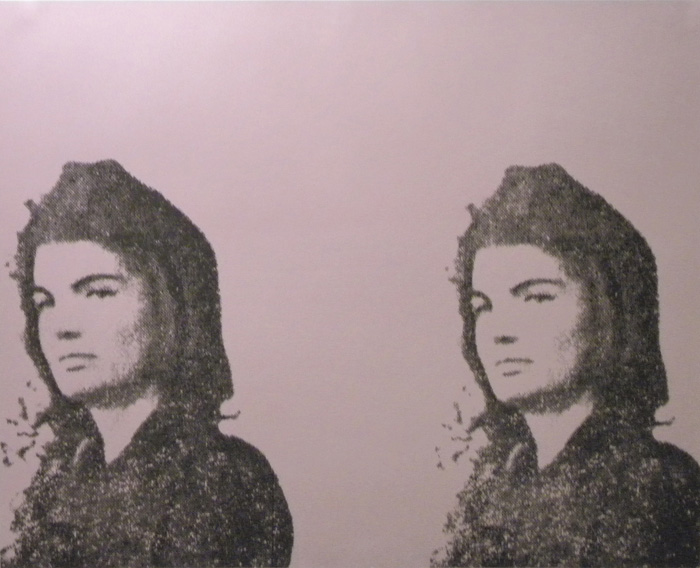
Andy Warhol, Jacqueline Kennedy II

Andy Warhol       Jacqueline Kennedy          1966

Andy Warhol Jacqueline Kennedy 1966

Andy Warhol
Jacqueline Kennedy II
1966
Screenprint on paper
24 x 30 in.
This piece is signed with a rubber stamp and numbered in pencil on verso.

About This Work:

This work captures first lady, Jackie Kennedy at her husband’s funeral. Andy Warhol chose this image of Jackie because of her expressionless state. Upon close inspection the viewer sees the doubled lack of emotion and feeling in her facial expression and her dead stare into space.

She had just lost her husband, and the country their beloved President JFK. Her blank stare and somber being symbolizes how America felt int his time of loss. America in a time of uncertainty and mourning was just as lost without JFK as Jackie Kennedy was without her husband.


About Andy Warhol:

He was one of the most enigmatic figures in American art. His work became the definitive expression of a culture obsessed with images. He was surrounded by a coterie of beautiful bohemians with names like Viva, Candy Darling, and Ultra Violet. He held endless drug- and sex-filled parties, through which he never stopped working. He single-handedly confounded the distinctions between high and low art. His films are pivotal in the formation of contemporary experimental art and pornography. He spent the final years of his life walking around the posh neighborhoods of New York with a plastic bag full of hundred dollar bills, buying jewelry and knick knacks. His name was Andy Warhol, and he changed the nature of art forever.

Andy Warhol was born Andrew Warhola on August 6, 1928, in Pittsburgh. He received his B.F.A. from the Carnegie Institute of Technology, Pittsburgh, in 1949. That same year, he moved to New York, where he soon became successful as a commercial artist and illustrator. During the 1950s, Warhol’s drawings were published in Glamour and other magazines and displayed in department stores. He became known for his illustrations of I. Miller shoes. In 1952, the Hugo Gallery in New York presented a show of Warhol’s illustrations for Truman Capote’s writings.

During this time, Warhol had also been working on a series of pictures separate from the advertisements and illustrations. It was this work that he considered his serious artistic endeavor. Though the paintings retained much of the style of popular advertising, their motivation was just the opposite. The most famous of the paintings of this time are the thirty-two paintings of Campbell soup cans. With these paintings, and other work that reproduced Coca-Cola bottles, Superman comics, and other immediately recognizable popular images, Warhol was mirroring society’s obsessions. Where the main concern of advertising was to slip into the unconscious and unrecognizably evoke a feeling of desire, Warhol’s work was meant to make the viewer actually stop and look at the images that had become invisible in their familiarity. These ideas were similarly being dealt with by artists such as Jasper Johns, Roy Lichtenstein, and Robert Rauschenberg — and came to be known as Pop Art.

Throughout the late 1950s and 1960s, Warhol produced work at an amazing rate. He embraced a mode of production similar to that taken on by the industries he was mimicking, and referred to his studio as “The Factory.” The Factory was not only a production center for Warhol’s paintings, silk-screens, and sculptures, but also a central point for the fast-paced high life of New York in the ’60s. Warhol’s obsession with fame, youth, and personality drew the most wild and interesting people to The Factory throughout the years. Among the regulars were Mick Jagger, Martha Graham, Lou Reed, and Truman Capote. For many, Warhol was a work of art in himself, reflecting back the basic desires of an consumerist American culture. He saw fame as the pinnacle of modern consumerism and reveled in it the way artists a hundred years before reveled in the western landscape. His oft-repeated statement that “every person will be world-famous for fifteen minutes” was an incredible insight into the growing commodification of everyday life.

By the mid-’60s, Warhol had become one of the most famous artists, in the world. He continued, however, to baffle the critics with his aggressively groundbreaking work. His paintings were primarily concerned with getting the viewer to look at something for longer than they otherwise would.

Throughout the ’70s and ’80s, Warhol produced hundreds of portraits, mostly in silk screen. His images of Liza Minnelli, Jimmy Carter, Albert Einstein, Elizabeth Taylor, and Philip Johnson express a more subtle and expressionistic side of his work.

Following routine gall bladder surgery, Andy Warhol died February 22, 1987. After his burial in Pittsburgh, his friends and associates organized a memorial mass at St. Patrick’s Cathedral in New York that was attended by more than 2,000 people.

WOW! – Work of the Week 3/30/15

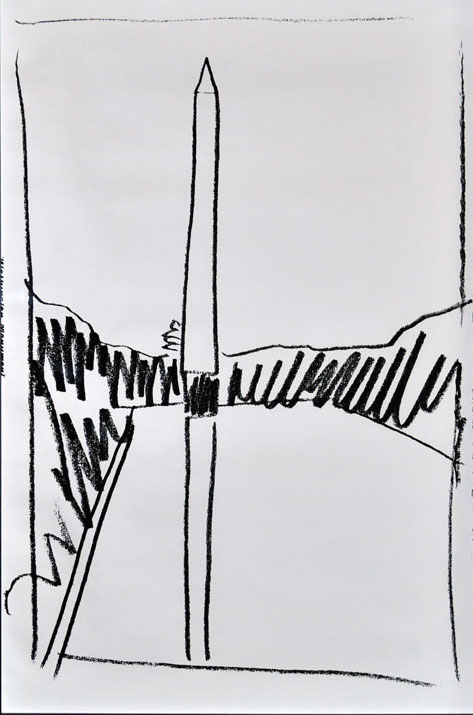
Andy Warhol, Washington Monument

Andy Warhol      Washington Monument       1974

Andy Warhol Washington Monument 1974

Andy Warhol
Washington Monument
1974
Screenprint on wallpaper
43 7/8 x 29 5/8 in.
This piece is stamped authentic by The andy Warhol Foundation on verso.

About This Work:

In 1974, the United States was in a very trying time, with much conflict, President Nixon’s resignation and a bumbling President Ford in office. All was in a state of flux and uncertainty. Warhol’s Washington Monument reassures the viewer that The United States will get through these troubling times.

The simple line drawing with the reflection of the Washington Moument on The Mall Lake symbolizes the country’s strength and stands as a rising beacon of freedom, hope and liberty. It is a reminder that America is the greatest country.


About Andy Warhol:

He was one of the most enigmatic figures in American art. His work became the definitive expression of a culture obsessed with images. He was surrounded by a coterie of beautiful bohemians with names like Viva, Candy Darling, and Ultra Violet. He held endless drug- and sex-filled parties, through which he never stopped working. He single-handedly confounded the distinctions between high and low art. His films are pivotal in the formation of contemporary experimental art and pornography. He spent the final years of his life walking around the posh neighborhoods of New York with a plastic bag full of hundred dollar bills, buying jewelry and knick knacks. His name was Andy Warhol, and he changed the nature of art forever.

Andy Warhol was born Andrew Warhola on August 6, 1928, in Pittsburgh. He received his B.F.A. from the Carnegie Institute of Technology, Pittsburgh, in 1949. That same year, he moved to New York, where he soon became successful as a commercial artist and illustrator. During the 1950s, Warhol’s drawings were published in Glamour and other magazines and displayed in department stores. He became known for his illustrations of I. Miller shoes. In 1952, the Hugo Gallery in New York presented a show of Warhol’s illustrations for Truman Capote’s writings.

During this time, Warhol had also been working on a series of pictures separate from the advertisements and illustrations. It was this work that he considered his serious artistic endeavor. Though the paintings retained much of the style of popular advertising, their motivation was just the opposite. The most famous of the paintings of this time are the thirty-two paintings of Campbell soup cans. With these paintings, and other work that reproduced Coca-Cola bottles, Superman comics, and other immediately recognizable popular images, Warhol was mirroring society’s obsessions. Where the main concern of advertising was to slip into the unconscious and unrecognizably evoke a feeling of desire, Warhol’s work was meant to make the viewer actually stop and look at the images that had become invisible in their familiarity. These ideas were similarly being dealt with by artists such as Jasper Johns, Roy Lichtenstein, and Robert Rauschenberg — and came to be known as Pop Art.

Throughout the late 1950s and 1960s, Warhol produced work at an amazing rate. He embraced a mode of production similar to that taken on by the industries he was mimicking, and referred to his studio as “The Factory.” The Factory was not only a production center for Warhol’s paintings, silk-screens, and sculptures, but also a central point for the fast-paced high life of New York in the ’60s. Warhol’s obsession with fame, youth, and personality drew the most wild and interesting people to The Factory throughout the years. Among the regulars were Mick Jagger, Martha Graham, Lou Reed, and Truman Capote. For many, Warhol was a work of art in himself, reflecting back the basic desires of an consumerist American culture. He saw fame as the pinnacle of modern consumerism and reveled in it the way artists a hundred years before reveled in the western landscape. His oft-repeated statement that “every person will be world-famous for fifteen minutes” was an incredible insight into the growing commodification of everyday life.

By the mid-’60s, Warhol had become one of the most famous artists, in the world. He continued, however, to baffle the critics with his aggressively groundbreaking work. His paintings were primarily concerned with getting the viewer to look at something for longer than they otherwise would.

Throughout the ’70s and ’80s, Warhol produced hundreds of portraits, mostly in silk screen. His images of Liza Minnelli, Jimmy Carter, Albert Einstein, Elizabeth Taylor, and Philip Johnson express a more subtle and expressionistic side of his work.

Following routine gall bladder surgery, Andy Warhol died February 22, 1987. After his burial in Pittsburgh, his friends and associates organized a memorial mass at St. Patrick’s Cathedral in New York that was attended by more than 2,000 people.

ANDY WARHOL: WITHSTANDING THE TEST OF TIME 3/12/15 – 4/11/15

ANDY WARHOL: WITHSTANDING THE TEST OF TIME

An exhibition of works by Andy Warhol from the 1960s to 1980s on view at Gregg Shienbaum Fine Art

MARCH 12 – APRIL 11, 2015

OPENING RECEPTION     COLLECTOR’S  THURSDAY, MARCH 12, 2015      

6PM-9PM

Andy Warhol        $ (Quadrant) FS II.284        1982

Andy Warhol $ (Quadrant) FS II.284 1982

$ (Quadrant) FS II.284

1982

Screenprint on Lenox Museum Board

40 x 32 in.

Edition of 60. Each print is unique.

This piece is signed and numbered in pencil.


About Andy Warhol:

He was one of the most enigmatic figures in American art. His work became the definitive expression of a culture obsessed with images. He was surrounded by a coterie of beautiful bohemians with names like Viva, Candy Darling, and Ultra Violet. He held endless drug- and sex-filled parties, through which he never stopped working. He single-handedly confounded the distinctions between high and low art. His films are pivotal in the formation of contemporary experimental art and pornography. He spent the final years of his life walking around the posh neighborhoods of New York with a plastic bag full of hundred dollar bills, buying jewelry and knick knacks. His name was Andy Warhol, and he changed the nature of art forever.

Andy Warhol was born Andrew Warhola on August 6, 1928, in Pittsburgh. He received his B.F.A. from the Carnegie Institute of Technology, Pittsburgh, in 1949. That same year, he moved to New York, where he soon became successful as a commercial artist and illustrator. During the 1950s, Warhol’s drawings were published in Glamour and other magazines and displayed in department stores. He became known for his illustrations of I. Miller shoes. In 1952, the Hugo Gallery in New York presented a show of Warhol’s illustrations for Truman Capote’s writings.

During this time, Warhol had also been working on a series of pictures separate from the advertisements and illustrations. It was this work that he considered his serious artistic endeavor. Though the paintings retained much of the style of popular advertising, their motivation was just the opposite. The most famous of the paintings of this time are the thirty-two paintings of Campbell soup cans. With these paintings, and other work that reproduced Coca-Cola bottles, Superman comics, and other immediately recognizable popular images, Warhol was mirroring society’s obsessions. Where the main concern of advertising was to slip into the unconscious and unrecognizably evoke a feeling of desire, Warhol’s work was meant to make the viewer actually stop and look at the images that had become invisible in their familiarity. These ideas were similarly being dealt with by artists such as Jasper Johns, Roy Lichtenstein, and Robert Rauschenberg — and came to be known as Pop Art.

Throughout the late 1950s and 1960s, Warhol produced work at an amazing rate. He embraced a mode of production similar to that taken on by the industries he was mimicking, and referred to his studio as “The Factory.” The Factory was not only a production center for Warhol’s paintings, silk-screens, and sculptures, but also a central point for the fast-paced high life of New York in the ’60s. Warhol’s obsession with fame, youth, and personality drew the most wild and interesting people to The Factory throughout the years. Among the regulars were Mick Jagger, Martha Graham, Lou Reed, and Truman Capote. For many, Warhol was a work of art in himself, reflecting back the basic desires of an consumerist American culture. He saw fame as the pinnacle of modern consumerism and reveled in it the way artists a hundred years before reveled in the western landscape. His oft-repeated statement that “every person will be world-famous for fifteen minutes” was an incredible insight into the growing commodification of everyday life.

By the mid-’60s, Warhol had become one of the most famous artists, in the world. He continued, however, to baffle the critics with his aggressively groundbreaking work. His paintings were primarily concerned with getting the viewer to look at something for longer than they otherwise would.

Throughout the ’70s and ’80s, Warhol produced hundreds of portraits, mostly in silk screen. His images of Liza Minnelli, Jimmy Carter, Albert Einstein, Elizabeth Taylor, and Philip Johnson express a more subtle and expressionistic side of his work.

Following routine gall bladder surgery, Andy Warhol died February 22, 1987. After his burial in Pittsburgh, his friends and associates organized a memorial mass at St. Patrick’s Cathedral in New York that was attended by more than 2,000 people.

WOW! – Work of The Week

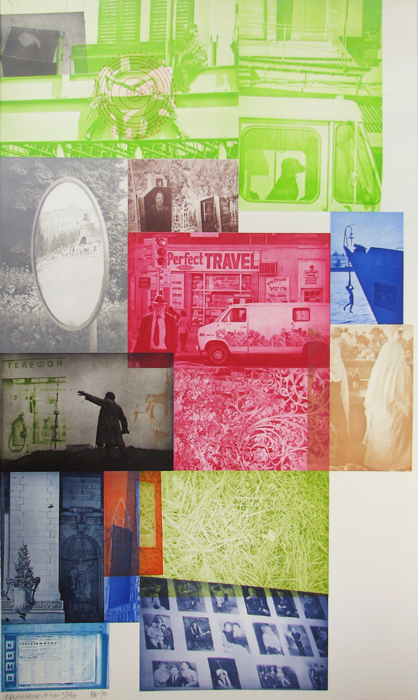
Robert Rauschenberg, Soviet American Array VI

Robert Rauschenberg, Soviet/American Array VI, 1990

Robert Rauschenberg, Soviet/American Array VI, 1990

Robert Rauschenberg
Soviet American Array VI
1990
Intaglio in 16 colors on Saunders paper
88 1/2 x 52 in.
Edition of 59
This piece is pencil signed and numbered.

About This Work:

Rauschenberg’s Soviet American Array VI  is one of a seven print series where he sought to address the politics of newfound peace constructively through his art. In 1989 Rauschenberg became the first American artist since WWII to have a solo show in the Soviet Union. His Moscow show in 1990 debuted his Soviet/American Array series.

The works of the Soviet/American Array series display photographs taken both in the United States and former Soviet Union to highlight the similarities and contrasts of the two major super powers of the Cold War. Rauschenberg juxtaposes photographic subjects that range from street signs to grand Soviet architecture to people immersed in their daily lives and jobs. When put together, these images bring attention to the ways we understand and define cultures, which are both complex and dynamic.


About Robert Rauschenberg:

Robert Rauschenberg began what was to be an artistic revolution. Rauschenberg’s enthusiasm for popular culture and his rejection of the angst and seriousness of the Abstract Expressionists led him to search for a new way of painting. He found his signature mode by embracing materials traditionally outside of the artist’s reach. He would cover a canvas with house paint, or ink the wheel of a car and run it over paper to create a drawing, while demonstrating rigor and concern for formal painting.

By 1958, at the time of his first solo exhibition at the Leo Castelli Gallery, his work had moved from abstract painting to drawings like “Erased De Kooning” (which was exactly as it sounds) to what he termed “combines.” These combines (meant to express both the finding and forming of combinations in three-dimensional collage) cemented his place in art history.

This pioneering altered the course of modern art. The idea of combining and of noticing combinations of objects and images has remained at the core of Rauschenberg’s work.

As Pop Art emerged in the ’60s, Rauschenberg turned away from three-dimensional combines and began to work in two dimensions, using magazine photographs of current events to create silk-screen prints. Rauschenberg transferred prints of familiar images, such as JFK or baseball games, to canvases and overlapped them with painted brushstrokes. They looked like abstractions from a distance, but up close the images related to each other, as if in conversation.

These collages were a way of bringing together the inventiveness of his combines with his love for painting. Using this new method he found he could make a commentary on contemporary society using the very images that helped to create that society.

In 1998 The Guggenheim Museum put on its largest exhibition ever with four hundred works by Rauschenberg, showcasing the breadth and beauty of his work, and its influence over the second half of the century.

WOW! – Work of the Week

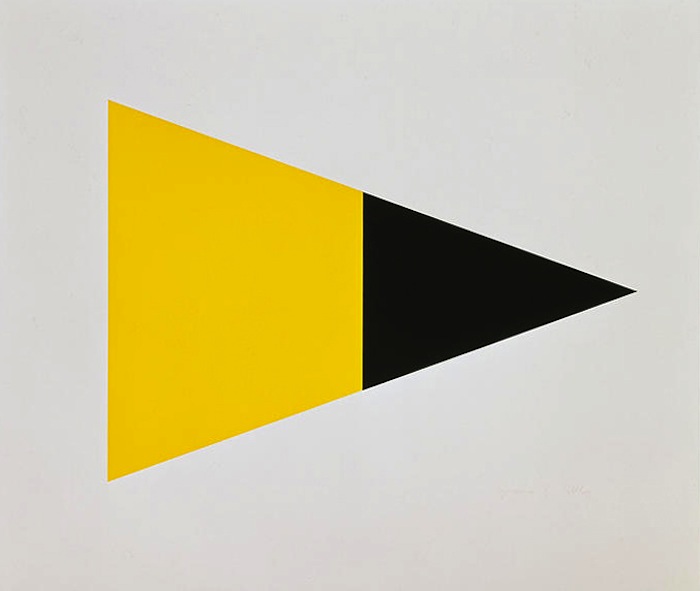
Ellsworth Kelly, Black Yellow

Ellsworth Kelly     Black Yellow     1972

Ellsworth Kelly   Black Yellow   1972

Ellsworth Kelly
Black Yellow
1972
Lithograph
34 x 39 3/4 in.
Edition of 55

This piece is pencil signed and numbered.

About This Work:

Ellsworth Kelly assembles his art’s constitute parts until they cohere to some point of emotional or intellectual satisfaction, much like an architect does. Its goal is to have the viewer moved by the purely visual.

This work by Kelly is a perfect example of how the artist juxtaposes discrete colored shapes. The colors lead our eye around the image in a kind of syncopated dance without ever allowing the shape to pop forward or sink back into a recessional space. This print is a “tour de force of restrained geometry and exuberant color.”


About Ellsworth Kelly:

“I have worked to free shape from its ground, and then to work the shape so that it has a definite relationship to the space around it; so that it has a clarity and a measure within itself of its parts (angles, curves, edges and mass); and so that, with color and tonality, the shape finds its own space and always demands its freedom and separateness.”- Ellsworth Kelly

Ellsworth Kelly is an American painter, sculptor, and printmaker associated with Hard-edge painting, Color Field painting and the Minimalist school. His works demonstrate unassuming techniques emphasizing the simplicity of form.

Although Kelly can now be considered an essential innovator and contributor to the American abstraction art movement, he was not always seen in such a positive light. It was hard for many to find the connection between Kelly’s art and the dominant stylistic trends  For Example, observing how light fragmented on the surface of water, he painted Seine (1950), made of black and white rectangles arranged by chance.

He created a new freedom of painterly expression.  He began working in extremely large formats and explored the concepts of seriality and monochrome paintings.  As a painter he worked in an exclusively abstract mode. By the late 1950s his painting stressed shape and planar masses (often assuming non-rectilinear formats). His work of this period also provided a useful bridge from the vanguard American geometric abstraction of the 1930s and early 1940s to the Minimalism and reductive art of the mid-1960s and 1970s.

Kelly has distilled his palette and introduced forms never before.  He starts with a rectangular canvas that he carefully paints with many coats of white paint; a shaped canvas, usually painted in a single bright color, is placed on top.  The quality of line seen in his paintings and in the form of his shaped canvases is very subtle.  The use of form and shadow, as well as the construction and deconstruction of the visible implies perfection.