WOW! – Work of the Week

Gregg Shienbaum Fine Art is proud to announce its first published edition with Ron English

Ron English, Combrat Boy

Ron English   Combrat Boy 3D Lenticular   2015

Ron English,   Combrat Boy 3D Lenticular,   2015

Ron English
Combrat Boy
2015
3D Lenticular archival ink on acrylic
36 x 24 in.
Edition of 10

This piece is signed and numbered on verso.

About This Work:

A long admirer of his work and the message behind his art, Gregg Shienbaum has always wanted to work with Ron English. Together they did not want to publish a silkscreen on paper, but instead opted for a 3D lenticular. By publishing the piece in a small edition  of 10, the piece is very limited, We expect to publish more editions of this caliber in the future.


About Ron English:

Ron English is an American contemporary artist who explores popular brand imagery and advertising. His signature style employs a mash-up of high and low cultural touchstones, including comic superhero mythology and totems of art history, to create a visual language of evolution. He is also widely considered a seminal figure in the advancement of street art away from traditional wild-style lettering and into clever statement and masterful trompe l’oeil based art. He has created illegal murals and billboards that blend stunning visuals with biting political, consumerist and surrealist statements, hijacking public space worldwide for the sake of art since the 1980s.

Culture jamming is one aspect of his work, involving ‘liberating’ commercial billboards with his own messages. Frequent targets of his work include Joe Camel, McDonald’s, and Mickey Mouse. Ron English can be considered the “celebrated prankster father of dollar-pop”, who wrangles carefully created corporate icons so that they are turned upside down, and are used against the very corporation they are meant to represent. Ron English is considered one of the fathers of modern street art. Some of his extralegal murals include one on the Berlin Wall’s Checkpoint Charlie in 1989 and one on the Palestinian separation wall in the West Bank in 2007, with fellow street artists Banksy and Swoon.

English is as well known for his photorealist technique and inventive use of color and comic book collage as he is for his unique cast of characters, including sexualized animals, skeletal figures, Marilyn Monroe with Mickey Mouse breasts, the corpulent fast food spokesman MC Supersized, and one of his most significant creations, Abraham Obama, a fusion of America’s 16th and 44th Presidents.

English takes inspiration from Andy Warhol and references him in his work. He also references the band KISS, and various cartoons. Also inspiration comes from the large billboards and posters he sees outside his Jersey City apartment, usually fast food companies.

English also references Picasso’s Guernica. He has created dozens of versions, transforming the original Spanish civilian characters into Disney characters, Peanuts characters, soccer players, schoolchildren, and many others. He also painted the world’s largest version of Guernica at the Station Museum in Houston. It is one foot longer and one foot wider than Picasso’s original and features schoolchildren playacting the violent scene of the original.
WOW! – Work of the Week

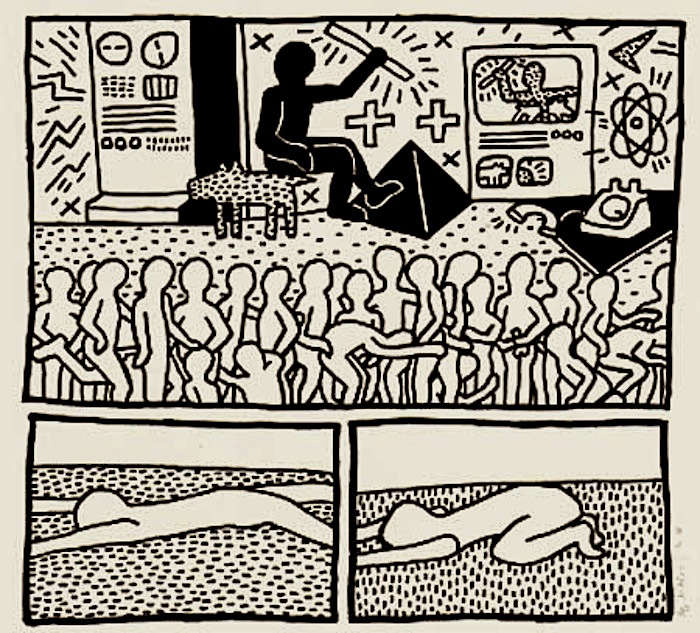
Keith Haring, Blueprint Drawing #15

Keith Haring  Blueprint Drawing #15 1990

Keith Haring Blueprint Drawing #15 1990


Keith Haring
Blueprint Drawing #15
1990
Silkscreen
42 1/2 x 47 in.
Edition of 33

This piece is pencil signed and numbered.

About This Work:

There are many iconic works by Haring, however the Blueprint Drawing series is the more narrative, where he talks about his life, his sexual preferences, how the world was infected and affected by the realization of mortality based on life choice and the alienation that occurred at the time. In a sense, this series was his autobiography and his outlook on the world around him.  Thus, he created this series at the end of his life. It actually is the last series he signed before he passed. There are certain series that artists create where you see and feel them in their work. For Andy Warhol and Jasper Johns, you see the artist in their early works. However for Haring,  you really see him and get a sense of knowing him in his later work. This could be because he was approaching death at such a young age.


About Keith Haring:

Keith Haring found a thriving alternative art community that was developing outside the gallery and museum system, in the downtown streets, the subways and spaces in clubs and former dance halls. Here he became friends with fellow artists Kenny Scharf and Jean-Michel Basquiat, as well as the musicians, performance artists and graffiti writers that comprised the burgeoning art community. Haring was swept up in the energy and spirit of this scene and began to organize and participate in exhibitions and performances at Club 57 and other alternative venues.

Haring was able to push his own youthful impulses toward a singular kind of graphic expression based on the primacy of the line. 

In 1980, Haring found a highly effective medium that allowed him to communicate with the wider audience he desired, when he noticed the unused advertising panels covered with matte black paper in a subway station. He began to create drawings in white chalk upon these blank paper panels throughout the subway system. Between 1980 and 1985, Haring produced hundreds of these public drawings in rapid rhythmic lines, sometimes creating as many as forty “subway drawings” in one day. This seamless flow of images became familiar to New York commuters, who often would stop to engage the artist when they encountered him at work. The subway became, as Haring said, a “laboratory” for working out his ideas and experimenting with his simple lines. 

Between 1980 and 1986, Haring achieved international recognition and participated in numerous group and solo exhibitions. His first solo exhibition in New York, held at the Tony Shafrazi Gallery in 1982, was immensely popular and received critical acclaim. During this period, he participated in highly renowned international survey exhibitions such as Documenta 7 in Kassel Germany, the São Paulo Biennial and the Whitney Biennial. Haring completed numerous public projects in the first half of the 80’s. 

Throughout his career, Haring devoted much of his time to public works, which often carried social messages. He produced more than 50 public artworks between 1982 and 1989, in dozens of cities around the world, many of which were created for charities, hospitals, children’s day care centers and orphanages

Haring was diagnosed with AIDS in 1988.  Haring enlisted his imagery during the last years of his life to speak about his own illness and generate activism and awareness about AIDS. 

During a brief but intense career that spanned the 1980s, Haring’s work was featured in over 100 solo and group exhibitions.  By expressing universal concepts of birth, death, love, sex and war, using a primacy of line and directness of message, Haring was able to attract a wide audience and assure the accessibility and staying power of his imagery, which has become a universally recognized visual language of the 20th century.

Keith Haring died of AIDS related complications at the age of 31 on February 16, 1990. 

Since his death, he has been the subject of several international retrospectives. The work of Keith Haring can be seen today in the exhibitions and collections of major museums around the world.