WOW! – Work of the Week 9/8/15

Andy Warhol, Alfred Hitchcock


Andy Warhol,      Alfred Hitchcock,      1983

Andy Warhol, Alfred Hitchcock, 1983


Andy Warhol 
Alfred Hitchcock
1983
Unique color screenprint
30 1/2 x 20 3/4 in.
Authenticated by The Andy Warhol Foundation and stamped by The Andy Warhol Estate on verso


About This Work:

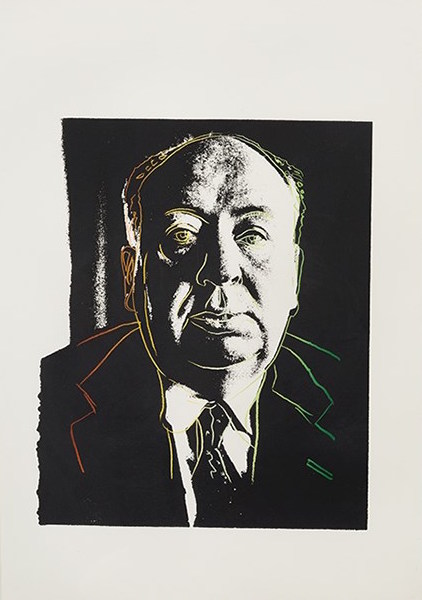
This work is a unique proof, based on a publicity photograph of the famed film director, Alfred Hitchcock. It is part of one of Warhol’s many commissioned projects, all of which reflect his avid interest in advertising and celebrity images. Warhol was asked to create the image for the Vanity Fair, March 1983 article, “The Trouble with Alfred” by Walter Clemons. The article’s basis detailed the contradictory sentiments of the director, which Warhol was able to illustrate by contrasting a black and white image of the director with gradated colored lines outlining his distinct round face and suit and tie. This unique proof however was not the final image selected by Vanity Fair for the magazine spread.

Warhol also made quite a few paintings with Alfred Hitchcock as his portrait subject. Warhol’s portraits of Hitchcock have been described by Christie’s as “a variation on the doubled self-image that Hitchcock played with in his title sequence, layering his own expressive line-drawing over the director’s silhouette, suggesting the mischievous defacement of graffiti as much as the canonization of a hero through the timelessness of the inscribed profile.” There is an apparent duality motif in all of Warhol’s renderings of the director as seen by Hitchcock’s stoic demeanor and monochrome complexion with Warhol’s playful sarcasm in the details of his tie.

At first thought, it would seem Warhol and Hitchcock had little in common. Rather they both directed films, but more over, began as visual artists – Warhol as a commercial illustrator and Hitchcock creating illustrations for title cards in silent movies. Much like Warhol’s artworks, Hitchcock’s films are renowned for their accessibility as well as their complexity. Viewers enjoy both as entertainment, while critics and scholars study both as layered works of cinematic and visual artistry. The concept of duality also pertains to themselves. Warhol and Hitchcock created public personas – Warhol as the vunderkind of the New York art scene and Hitchcock as ‘The Master of Suspense,’ but both were rather private men. Such contradiction comments on their two poles of creative energy as both the artist and the artwork. in this work, Warhol is able to show us through a unique gaze, Hitchcock himself as the masterpiece.


About The Artist:

He was one of the most enigmatic figures in American art. His work became the definitive expression of a culture obsessed with images. He was surrounded by a coterie of beautiful bohemians with names like Viva, Candy Darling, and Ultra Violet. He held endless drug- and sex-filled parties, through which he never stopped working. He single-handedly confounded the distinctions between high and low art. His films are pivotal in the formation of contemporary experimental art and pornography. He spent the final years of his life walking around the posh neighborhoods of New York with a plastic bag full of hundred dollar bills, buying jewelry and knick knacks. His name was Andy Warhol, and he changed the nature of art forever.

Andy Warhol was born Andrew Warhola on August 6, 1928, in Pittsburgh. He received his B.F.A. from the Carnegie Institute of Technology, Pittsburgh, in 1949. That same year, he moved to New York, where he soon became successful as a commercial artist and illustrator. During the 1950s, Warhol’s drawings were published in Glamour and other magazines and displayed in department stores. He became known for his illustrations of I. Miller shoes. In 1952, the Hugo Gallery in New York presented a show of Warhol’s illustrations for Truman Capote’s writings. 

During this time, Warhol had also been working on a series of pictures separate from the advertisements and illustrations. It was this work that he considered his serious artistic endeavor. Though the paintings retained much of the style of popular advertising, their motivation was just the opposite. The most famous of the paintings of this time are the thirty-two paintings of Campbell soup cans. With these paintings, and other work that reproduced Coca-Cola bottles, Superman comics, and other immediately recognizable popular images, Warhol was mirroring society’s obsessions. Where the main concern of advertising was to slip into the unconscious and unrecognizably evoke a feeling of desire, Warhol’s work was meant to make the viewer actually stop and look at the images that had become invisible in their familiarity. These ideas were similarly being dealt with by artists such as Jasper Johns, Roy Lichtenstein, and Robert Rauschenberg — and came to be known as Pop Art.

Throughout the late 1950s and 1960s, Warhol produced work at an amazing rate. He embraced a mode of production similar to that taken on by the industries he was mimicking, and referred to his studio as “The Factory.” The Factory was not only a production center for Warhol’s paintings, silk-screens, and sculptures, but also a central point for the fast-paced high life of New York in the ’60s. Warhol’s obsession with fame, youth, and personality drew the most wild and interesting people to The Factory throughout the years. Among the regulars were Mick Jagger, Martha Graham, Lou Reed, and Truman Capote. For many, Warhol was a work of art in himself, reflecting back the basic desires of an consumerist American culture. He saw fame as the pinnacle of modern consumerism and reveled in it the way artists a hundred years before reveled in the western landscape. His oft-repeated statement that “every person will be world-famous for fifteen minutes” was an incredible insight into the growing commodification of everyday life.

By the mid-’60s, Warhol had become one of the most famous artists, in the world. He continued, however, to baffle the critics with his aggressively groundbreaking work. His paintings were primarily concerned with getting the viewer to look at something for longer than they otherwise would. 

Throughout the ’70s and ’80s, Warhol produced hundreds of portraits, mostly in silk screen. His images of Liza Minnelli, Jimmy Carter, Albert Einstein, Elizabeth Taylor, and Philip Johnson express a more subtle and expressionistic side of his work. 

 Following routine gall bladder surgery, Andy Warhol died February 22, 1987. After his burial in Pittsburgh, his friends and associates organized a memorial mass at St. Patrick’s Cathedral in New York that was attended by more than 2,000 people.

For more information and price please contact the gallery at info@gsfineart.com

WOW! – Work of the Week 9/1/15

Robert Rauschenberg, Waves


Robert Rauschenberg,      Waves, from Stoned Moon,      1969

Robert Rauschenberg, Waves, from Stoned Moon, 1969


Robert Rauschenberg 
Waves, from Stoned Moon
1969
Lithograph
89 x 42 in.
Edition of 27
Pencil signed and numbered


About This Work:

In 1969, NASA invited artist Robert Rauschenberg to witness the launch of Apollo 11, the spacecraft that would place man on the moon for the first time. The launch of Apollo 11 was seen as the most significant technological advancement. In terms of the global political climate, it marked the apex of the ‘space race’. 

For Rauschenberg, the moon mission represented a crucial occasion, far beyond the obvious scientific headway. Rather, the launch marked the end of a decade that had left Rauschenberg completely disillusioned. Prior to his official opportunity to witness man’s mission to the Moon, the core of his works in the 1960s incorporated popular political and social subject matter of war and destruction, as seen by media images of the Vietnam war, America’s race riots and the assassinations of JFK and Martin Luther King. The launch gave him a new hope for the future. 

His Stoned Moon series consists of 34 works that cleverly captured the essence of the historical event far beyond any Walter Cronkite broadcast or television marathon. In his work Waves, one of the best and largest black-and-white images of the series, Rauschenberg sets the print in two landscapes the Earth and the Moon. Rauschenberg chose to appropriate two of the first pictures taken from the Moon in the bottom of the work. In the bottom right corner we see Neil Armstrong in his space suit taking his famous steps for mankind and on the left we see a reproduction of Aldrin’s photograph of his very own boot print. We also see astronauts floating in space and even the lunar modular on the moon at in the bottom of the work, which is set on the Moon and in space. Whereas, the top part of the work we can seen a scene from Earth, where the rocket is launching into space leaving plumes of smoke behind. Rauschenberg’s careful black-and-white scheme of Waves mimics the monochromatic nature of the Moon’s surface to emphasize the strange and mysterious atmosphere of the ‘Stoned moon’ as a visual metaphor for the future of man and technology.

The brushstrokes seen through out the work are seen as Rauschenberg’s artistic ties with Abstract Expressionism. Waves is a great example that shows Rauschenberg’s bridging the gap between Abstract Expressionism and Pop Art – a style that made him famous and one of the most important contemporary artists.


About The Artist:

Robert Rauschenberg began what was to be an artistic revolution. Rauschenberg’s enthusiasm for popular culture and his rejection of the angst and seriousness of the Abstract Expressionists led him to search for a new way of painting. He found his signature mode by embracing materials traditionally outside of the artist’s reach. He would cover a canvas with house paint, or ink the wheel of a car and run it over paper to create a drawing, while demonstrating rigor and concern for formal painting.

By 1958, at the time of his first solo exhibition at the Leo Castelli Gallery, his work had moved from abstract painting to drawings like “Erased De Kooning” (which was exactly as it sounds) to what he termed “combines.” These combines (meant to express both the finding and forming of combinations in three-dimensional collage) cemented his place in art history.

This pioneering altered the course of modern art. The idea of combining and of noticing combinations of objects and images has remained at the core of Rauschenberg’s work.

As Pop Art emerged in the ’60s, Rauschenberg turned away from three-dimensional combines and began to work in two dimensions, using magazine photographs of current events to create silk-screen prints. Rauschenberg transferred prints of familiar images, such as JFK or baseball games, to canvases and overlapped them with painted brushstrokes. They looked like abstractions from a distance, but up close the images related to each other, as if in conversation.

These collages were a way of bringing together the inventiveness of his combines with his love for painting. Using this new method he found he could make a commentary on contemporary society using the very images that helped to create that society.

In 1998 The Guggenheim Museum put on its largest exhibition ever with four hundred works by Rauschenberg, showcasing the breadth and beauty of his work, and its influence over the second half of the century. 

For more information and price please contact the gallery at info@gsfineart.com

WOW! – Work of the Week 8/24/15

Roy LichtensteinLandscape with Boats

Landscape with BoatsRoy Lichtenstein 
Landscape with Boats
1996
Lithograph and screenprint in colors on Lanaquarelle watercolor paper
27 7/8 x 58 1/8 in.
Edition of 60
Pencil signed, dated and numbered

About This Work:

In Roy Lichtenstein’s Landscapes in the Chinese Style, Lichtenstein’s engagement with the Chinese landscape tradition, in this case the Chinese tradition of the Song Dynasty, appears to reflect both light-hearted irony and a more somber appreciation for the beauty of the form.

Lichtenstein was greatly influenced by Edgar Degas’ 1944 exhibition at the Metropolitan Museum. He was struck by Degas’ ability to suggest the features of a landscape with just a few strategic swathes of gray, thus allowing an unformed, nebulous shape to stand for exacting form.

This work is first a landscape: you can see a little boat in the corner where two men are trying to find their way. It’s very moving because of the disproportionate scale between the sea and the figure. On the other hand, this image is really quite abstract, the shapes dramatically flowing around the space. It summarizes many of the issues that interested Lichtenstein throughout his career, particularly this tension between the figurative and the abstract.

Lichtenstein re-interpreted the traditional scenes and motifs using his own established methods and materials. He reflects on the harmony and balance of the ancient works through his unmistakable and edgy lexicon of modern visual effects.  Carefully stylized, Landscapes in the Chinese Style are formed with simulated Benday dots and block contours, rendered in hard, vivid color.  The overt irony of his earlier Pop works cedes to aestheticism and formal delicacy: the Benday dots do not mimic the arbitrary techniques of commercial illustration, but rather appear in cloud-like patches that express the effervescence of space and form, as in this dreamy, abstract work called Landscape with Boats.


About The Artist:

Roy Lichtenstein (October 27, 1923 – September 29, 1997) was a prominent American pop artist. His work defined the basic premise of pop art better than any other through parody.  Favoring the old-fashioned comic strip as subject matter, Lichtenstein produced hard-edged, precise compositions that documented while it parodied often in a tongue-in-cheek humorous manner. 

In 1961, Lichtenstein began his first pop paintings using cartoon images and techniques derived from the appearance of commercial printing. This phase would continue to 1965, and included the use of advertising imagery suggesting consumerism and homemaking.  His first work to feature the large-scale use of hard-edged figures and Ben-Day dots was Look Mickey  in 1961.  This piece came from a challenge from one of his sons, who pointed to a Mickey Mouse comic book and said; “I bet you can’t paint as good as that, eh, Dad?”  

Lichtenstein had his first one-man show at the Castelli gallery in 1962; the entire collection was bought by influential collectors before the show even opened.  It was at this time, that Lichtenstein began to find fame not just in America, but worldwide.  His work featured thick outlines, bold colors and Ben-Day dots to represent certain colors, as if created by photographic reproduction.  However, rather than attempt to reproduce his subjects, his work tackled the way mass media portrays them.

In the 1970s and 1980s, his style began to loosen and he expanded on what he had done before.  His style was replaced with more surreal works.  His “mirror” paintings consist of sphere-shaped canvases with areas of color and dots.  Lichtenstein also created a series of still lifes (paintings that show inanimate objects) in different styles during the 1970s. In the 1980s and 1990s, Lichtenstein began to mix and match styles. Often his works relied on optical (relating to vision) tricks, drawing his viewers into a debate over the nature of “reality.”

Lichtenstein’s work is included in numerous museums, such as the Albright-Knox Art Gallery, Buffalo, NY; Art Institute of Chicago, Chicago; Denver Art Museum, Denver; Metropolitan Museum of Art, NY; Foundation Beyeler, Basel, Switzerland; Museum of Contemporary Art, Los Angeles, Museum of Modern Art, New York; National Gallery of Art, Washington D.C.; Philadelphia Museum of Art, Philadelphia; Solomon R. Guggenheim Museum, New York; Stedelijk Museum, Amsterdam; and Whitney Museum of American Art, New York. 

For more information and price please contact the gallery at info@gsfineart.com
WOW! – Work of the Week 8/17/15

Jasper Johns, Device

Jasper Johns, Device, 1971-72

Jasper Johns, Device, 1971-72

Jasper Johns
Device
1971-72
Lithograph
38 1/2 x 29 in.
Edition of 62
This piece is signed and numbered in pencil.

About This Work:

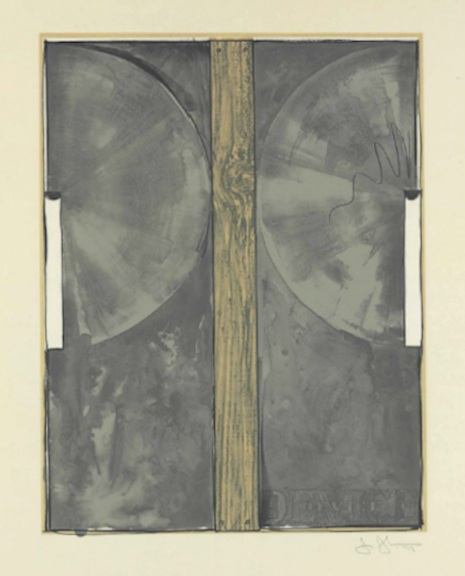
Device is an important work from Japser Johns’ gray period, as it is derived from his famous painting Device (1962-63), which shows his experimentation with mechanism and its relation to the artist’s hand.

In the early 1960s, Johns introduced a new process-driven motif referred to as “device” that he used to make his works. He would apply paint with a studio or household object rather than a paint brush, and then often affix those objects to the canvas. For Johns, the “device”  whether ruler, wooden slat or broom is an extension of the artist’s hand, much like the paint brush.

Works from John’s gray period are highly sought after. For Johns, the color gray, serves as a means of emphasizing the physical properties of an object by draining it of color. However, his use of gray as a color draws attention to the condition of gray itself, elevating it to more than a color, but also as an idea and material.


About The Artist:

In the late 1950’s, Jasper Johns emerged as force in the American art scene. His richly worked paintings of maps, flags, and targets led the artistic community away from Abstract Expressionism toward a new emphasis on the concrete. Johns laid the groundwork for both Pop Art and Minimalism. Today, his prints and paintings set record prices at auction.

Born and raised in Allendale, South Carolina, Jasper Johns grew up wanting to be an artist.  He studied briefly at the University of South Carolina before moving to New York in the early fifties.

After a visit to Philadelphia, with his good friend Robert Rauschenberg, to see Marcel Duchamp’s painting, The Large Glass (1915-23), Johns became very interested in his work. Duchamp had revolutionized the art world with his “readymades” — a series of found objects presented as finished works of art. This irreverence for the fixed attitudes toward what could be considered art was a substantial influence on Johns. 

The modern art community was searching for new ideas to succeed the pure emotionality of the Abstract Expressionists. Johns’ paintings of targets, and maps, invited both the wrath and praise of critics. Johns’ early work combined a serious concern for the craft of painting with an everyday, almost absurd, subject matter. The meaning of the painting could be found in the painting process itself. It was a new experience for gallery goers to find paintings solely of such things as flags and numbers. 

The simplicity and familiarity of the subject matter piqued viewer interest in both Johns’ motivation and his process.   Johns explains, “There may or may not be an idea, and the meaning may just be that the painting exists.” 

In 1958, gallery owner Leo Castelli visited Rauschenberg’s studio and saw Johns’ work for the first time. Castelli was so impressed with the 28-year-old painter’s ability and inventiveness that he offered him a show on the spot. At that first exhibition, the Museum of Modern Art purchased three pieces, making it clear that at Johns was to become a major force in the art 

Over the past fifty years Johns has created a body of rich and complex work. His rigorous attention to the themes of popular imagery and abstraction has set the standards for American art. Constantly challenging the technical possibilities of printmaking, painting and sculpture, Johns laid the groundwork for a wide range of experimental artists. Today, he remains at the forefront of American art, with work represented in nearly every major museum collection.

WOW! – Work of the Week 8/10/15

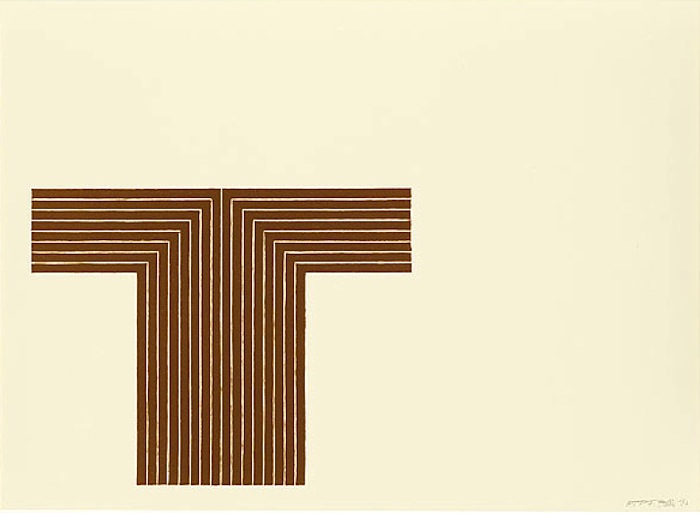
Frank Stella, Telluride

Frank Stella,     Telluride, from Copper Series,     1970

Frank Stella, Telluride, from Copper Series, 1970


Frank Stella
Telluride, from Copper Series
1970
Lithograph in colors on Arjomari paper
16 x 22 in.
Edition of 75
Pencil signed and numbered

About This Work:

Frank Stella’s seven Copper Series prints are based on his Copper Series paintings of 1960-61. Titles of the individual works refer to towns near the San Juan Mountains in Colorado which had active copper and silver mines at the turn of the century, but whose reserves have since been depleted. Like his Aluminum Series prints, the lithographic inks and over-varnishes of the Copper Series were printed on paper that was first screenprinted.

The other 6 works of the Copper Series are titled Creede I, Creede II, Lake City, Pagosa Springs, Ouray and Ophir.


About Frank Stella:

Frank Stella is an American painter and printmaker, significant in the art movements of minimalism and post-painterly abstraction.

He is one of the most well-regarded postwar American painters still working today. Notably, he is heralded for creating abstract paintings that bear no pictorial illusions or psychological or metaphysical references in twentieth-century painting.

Early visits to New York art galleries influenced his artist development, and his work was influenced by the abstract expressionism of Jackson Pollock and Franz Kline.  Upon moving to New York City, he reacted against the expressive use of paint by most painters of the abstract expressionist movement, instead finding himself drawn towards the “flatter” surfaces of Barnett Newman’s work and the “target” paintings of Jasper Johns. He began to produce works which emphasized the picture-as-object, rather than the picture as a representation of something, be it something in the physical world, or something in the artist’s emotional world.

“A picture is a flat surface with paint on it – nothing more”.

Many of Stella’s works are created by simply using the path of the brush stroke, very often using common house paint, in which regular bands of paint were separated by very thin pinstripes of unpainted canvas.  Stella’s art was recognized for its innovations before he was twenty-five.

In the 1960s, Stella began to use a wider range of colors, typically arranged in straight or curved lines. Later he began his Protractor Series (71) of paintings, in which arcs, sometimes overlapping, within square borders are arranged side-by-side to produce full and half circles painted in rings of concentric color.

In 1970, The Museum of Modern Art in New York presented a retrospective of Stella’s work, making him the youngest artist to receive one.  During the 1970’s Stella introduced relief into his art, which he came to call “maximalist” painting for its sculptural qualities.  It is ironic that these paintings were completely, the opposite of what had brought him fame, the decade before.  His work also became more three-dimensional to the point where he started producing large, free-standing metal pieces, which, although they are painted upon, might well be considered sculpture.

In the 1980’s & 1990’s, the increasingly deep relief of Stella’s paintings gave way to full three-dimensionality, with sculptural forms derived from cones, pillars, French curves, waves, and decorative architectural elements.  In the 1990s, Stella began making free-standing sculpture for public spaces and developing architectural projects.

Stella’s work was included in several important exhibitions that defined 1960s art, among them the Solomon R. Guggenheim Museum’s The Shaped Canvas (1965) and Systemic Painting (1966). His art has been the subject of several retrospectives in the United States, Europe, and Japan.

For more information and price please contact the gallery at info@gsfineart.com
WOW! – Work of the Week 8/3/15

Robert Mangold, Ring Image B

Robert Mangold,     Ring Image B,     2008

Robert Mangold, Ring Image B, 2008


Robert Mangold
Ring Image B
2008
Screenprint
30 3/4 x 29 1/2 in.
Edition of 35
Pencil signed and numbered

About This Work:

In Ring Image B, Robert Mangold uses shape, line, and color to explore formal relationships. While this work may appear simple, it is rather a complex abstract work of architectural scale with thick and thin graphite lines.  Mangold has drawn upon abstract minimalist forms in this curvilinear composition of a ring where he provokes the consideration of the idea of a painting without a center, which also reflects ancient pottery and formal studies by Renaissance masters.


About Robert Mangold:

“Robert Mangold’s paintings, are more complicated to describe than they seem, which is partly what’s good about them: the way they invite intense scrutiny, which, in the nature of good art, is its own reward.”  – Michael Kimmelmann, New York Times

Robert Mangold is an American minimalist artist.  His works are comprised often of simple elements which are put together through complex means.  He renders the surface of each canvas with subtle color modulations and sinewy, hand drawn graphite lines. While his focus on formal considerations may seem paramount, he also delights in thwarting those considerations—setting up problems for the viewer. Over the course of years and in multiple series of shaped canvases that explore variations on rings, columns, trapezoids, arches, and crosses, he has also provoked viewers to consider the idea of paintings without centers.

Mangold’s work challenges the typical connotations of what a painting is or could be, and his works often appear as objects rather than images. Elements refer often to architectural elements or have the feeling of an architect’s hands.

In 1967, he won a National Endowment for the Arts grant and in 1969, a Guggenheim Fellowship. In 1971, he had his first solo museum exhibition at the Guggenheim Museum. He has been featured in the Whitney Biennial four times, in 1979, 1983, 1985, and 2004.

His work is in many museum collections, including the Museum of Modern Art and the Whitney Museum of American Art in New York, the San Francisco Museum of Modern Art, and the Tate Collection in London.

For more information and price please contact the gallery at info@gsfineart.com

WOW! – Work of the Week 7/27/15

John Baldessari, Two Unfinished Letters

Two Unfinished LettersJohn Baldessari
Two Unfinished Letters
1992-93
Screenprint and lithograph on Arches 88 paper with slight deckle
33 1/2 x 21 in.
Edition of 80
This piece is signed and numbered in ink.

About This Work:

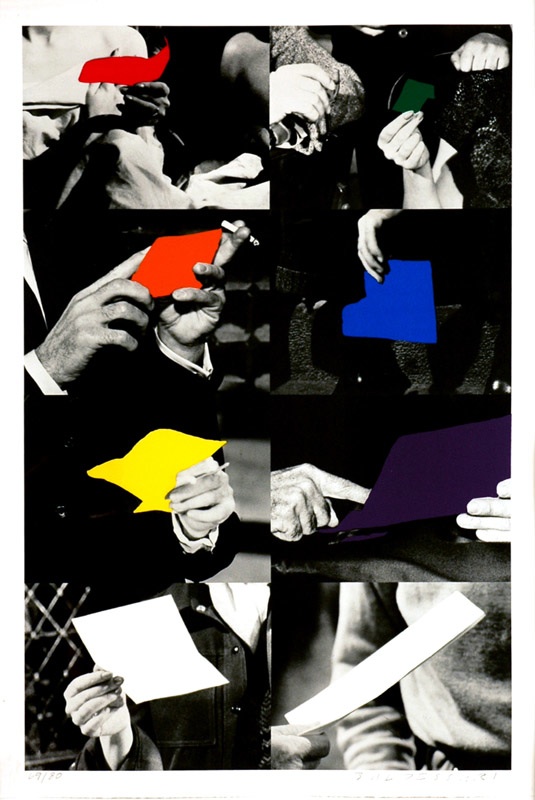
John Baldessari makes art that forces people to think. He presents the viewers with enigmatic compositions that suggest manifold interpretations but dictate none. Perhaps his most consistent objective over a half-century of work has been his desire to redirect ways of seeing, challenge how we look at the world, by proposing unexpected scenes or spotlighting the mundane and underrecognized.

In Two Unfinished Letters, John Baldessari depicts eight movies scenes where people are holding pieces of paper, bringing our attention to the various ways people both handle and read letters. Something that more often than not goes unnoticed, but has been integral in the way we communicate.


About John Baldessari:

Throughout his career, John Baldessari has defied formalist categories by working in a variety of media—creating films, videotapes, prints, photographs, texts, drawings, and multiple combinations of these. In his use of media imagery, Baldessari is a pioneer “image appropriator,” and as such has had a profound impact on post-modern art production. 

Born in 1931, John Baldessari studied art, literature, and art history at San Diego State College and the University of California, Berkeley.  Baldessari initially studied to be an art critic at the University of California, Berkeley during the mid 1950s, but growing dissatisfied with his studies, he turned to painting. Inspired by Dada and Surrealist literary and visual ideas, he began incorporating photographs, notes, texts, and fragments of conversation into his paintings. Baldessari remains fundamentally interested in de-mystifying artistic processes, and uses video to record his performances, which function as “deconstruction experiments.” These illustrative exercises target prevailing assumptions about art and artists, focusing on the perception, language, and interpretation of artistic images.  

Allowing pop-cultural artifacts to function as “information,” as opposed to “form,” Baldessari’s works represented a radical departure from, and often a direct critique of, the modernist sensibility that dominated painting for decades.

WOW! – Work of the Week 7/20/15

Roy Lichtenstein, Study of Hands

Roy Lichtenstein,      Study of Hands,      1981

Roy Lichtenstein, Study of Hands, 1981


Roy Lichtenstein
Study of Hands
1981
Lithograph and screenprint
31 15/16 x 32 3/4 in.
Edition of 100
This piece is signed, dated and numbered in pencil.

About This Work:

Throughout history, artists have always been fascinated with drawing hands, because while they seem simple they are deceptively complex. In Study of Hands, Lichtenstein draws on the history of studying hands. In his version of studying hands he shows us his artistic styles, which include his woodgrain, lines and geometric, Benday dot and cartoon. All four of these styles are prevalent in all his works.


About Roy Lichtenstein:

Roy Lichtenstein (October 27, 1923 – September 29, 1997) was a prominent American pop artist. His work defined the basic premise of pop art better than any other through parody.  Favoring the old-fashioned comic strip as subject matter, Lichtenstein produced hard-edged, precise compositions that documented while it parodied often in a tongue-in-cheek humorous manner. 

In 1961, Lichtenstein began his first pop paintings using cartoon images and techniques derived from the appearance of commercial printing. This phase would continue to 1965, and included the use of advertising imagery suggesting consumerism and homemaking.  His first work to feature the large-scale use of hard-edged figures and Ben-Day dots was Look Mickey  in 1961.  This piece came from a challenge from one of his sons, who pointed to a Mickey Mouse comic book and said; “I bet you can’t paint as good as that, eh, Dad?”  

Lichtenstein had his first one-man show at the Castelli gallery in 1962; the entire collection was bought by influential collectors before the show even opened.  It was at this time, that Lichtenstein began to find fame not just in America, but worldwide.  His work featured thick outlines, bold colors and Ben-Day dots to represent certain colors, as if created by photographic reproduction.  However, rather than attempt to reproduce his subjects, his work tackled the way mass media portrays them.

In the 1970s and 1980s, his style began to loosen and he expanded on what he had done before.  His style was replaced with more surreal works.  His “mirror” paintings consist of sphere-shaped canvases with areas of color and dots.  Lichtenstein also created a series of still lifes (paintings that show inanimate objects) in different styles during the 1970s. In the 1980s and 1990s, Lichtenstein began to mix and match styles. Often his works relied on optical (relating to vision) tricks, drawing his viewers into a debate over the nature of “reality.”

Lichtenstein’s work is included in numerous museums, such as the Albright-Knox Art Gallery, Buffalo, NY; Art Institute of Chicago, Chicago; Denver Art Museum, Denver; Metropolitan Museum of Art, NY; Foundation Beyeler, Basel, Switzerland; Museum of Contemporary Art, Los Angeles, Museum of Modern Art, New York; National Gallery of Art, Washington D.C.; Philadelphia Museum of Art, Philadelphia; Solomon R. Guggenheim Museum, New York; Stedelijk Museum, Amsterdam; and Whitney Museum of American Art, New York. 

WOW! – Work of the Week 7/13/15

Damien Hirst, Methylamine-13c

Damien Hirst     Methylamine-13c     2014

Damien Hirst Methylamine-13c 2014

Damien Hirst
Methylamine-13c
2014
Screenprint with glaze and diamond dust
33 1/16 x 27 in.
Edition of 100
This piece is signed and numbered in pencil on verso.

About This Work:

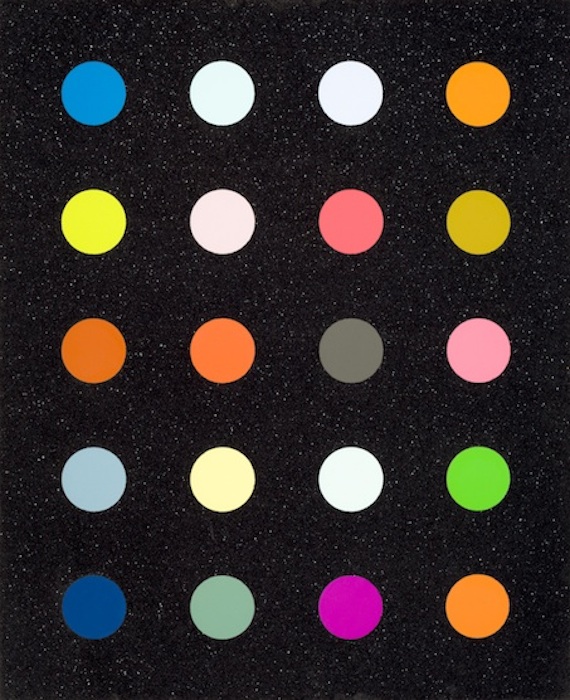
Hirst’s spot paintings and prints are amongst his most widely recognized works, with the ‘Pharmaceutical’ paintings first and most prolific of the 13 spots sub-series.

His work with spots, specifically when named after synthetic and natural compounds in drugs and pharmaceuticals, explores themes fundamental to the his work. Namely the complex relationships between nature and science, myth and reality, art and beauty, and life and death.

No one color spot is the same color as another. The colors he uses in conjunction with drug and pharmaceutical titles suggests they represent different emotions/states e.g. red means love, white means purity, black means death, blue means the blues, green means jealousy. Alluding to that fact, that all human emotions or sensations or natural science can be expressed, aesthetically, in the spots.


About Damien Hirst:

Damien Hirst has become one of the most prominent artists of his generation. Many of his works are widely recognized, from the shark suspended in formaldehyde, “The Physical Impossibility of Death in the Mind of Someone Living”, and his spot, spin and butterfly paintings, through to later works such as the diamond skull “For the Love of God”.

Throughout his work, Hirst investigates and challenges contemporary belief systems, and dissects the tensions and uncertainties at the heart of human experience.  Hirst takes a direct approach to ideas about existence, exploring the complex relationship between art, life, death and religion. His work calls into question our awareness and convictions about the boundaries that separate desire and fear, reason and faith, love and hate.

By using the tools and iconography of science and religion, he blurs the lines between science, religion, and art, giving the viewer the horror of immortality and the brilliance of reality. 

Death is a central theme in Hirst’s art work.  He gives his audience an open mouth astonishment while challenging the viewer to confront the inevitability of existence. He became famous for a series of artworks in which dead animals (including a shark, a sheep and a cow) are preserved—sometimes having been dissected—in formaldehyde. The best known of these being The Physical Impossibility of Death in the Mind of Someone Living, a 14-foot tiger shark immersed in formaldehyde in a vitrine

In September 2008, he took an unprecedented move for a living artist by selling a complete show, Beautiful Inside My Head Forever, at Sotheby’s by auction and by-passing his long-standing galleries.  The auction exceeded all predictions, raising $198 million, breaking the record for a one-artist auction.

Since 1987, over 80 solo shows of Damien Hirst exhibitions have taken place worldwide, and his work has been included in over 260 group shows.  His contributions to art over the last two and a half decades was recognized in 2012 with a major retrospective of his work at the Tate Modern.

WOW! – Work of the Week 6/29/15

Robert Indiana, Zinnia, from Garden of Love

Robert Indiana          Zinnia, from Garden of Love          1982

Robert Indiana Zinnia, from Garden of Love 1982

Robert Indiana
Zinnia, from Garden of Love
1982
Screenprint
26 5/8 x 26 5/8 in.
Edition of 100
This piece is signed, titled, dated and numbered in pencil.

About This Work:

Robert Indiana is most recognized for his very pop art LOVE works. 

Zinnia is one of 6 works from Robert Indiana’s Garden of Love portfolio. Each of the six works is inspired and named after a flower.


About Robert Indiana:

“There have been many American SIGN painters, but there never were any American sign PAINTERS.”   This sums up Robert Indiana’s position in the world of contemporary art. He has taken the everyday symbols of roadside America and made them into brilliantly colored geometric pop art. In his work he has been an ironic commentator on the American scene. Both his graphics and his paintings have made cultural statements on life and, during the rebellious 1960s, pointed political statements as well.

Born Robert Clark in New Castle, Indiana, in 1928, he adopted the name of his native state as a pseudonymous surname early in his career.

What Indiana calls “sculptural poems”,  his work often consists of bold, simple, iconic images, especially numbers and short words like “EAT”, “HUG”, and “LOVE”.

Rather than using symbols from the mass media, Indiana makes images of words that focus on identity.  Using them in bold block letters in vivid colors, he has enticed his viewers to look at the commonplace from a new perspective.

Despite his unique methods, several important aspects of Indiana’s works clearly identify him as a Pop artist. He manages to give a direct and honest description of American culture while appearing cool and uninvolved, much as Warhol did by simply reproducing images of superstars and soup can labels.  In his most famous series Indiana took familiar words, usually three to five letters long, and repeated, reflected, or divided them. The simple familiarity of these words and the flattened manner in which Indiana presents them demonstrates the Pop art accessibility of content; viewers need not read much past the surface.

However, what distinguishes Indiana from his “Pop” colleagues is the depth of his personal engagement with his subject matter.  Indiana’s works all speak to the vital forces that have shaped American culture in the late half of the 20th century: personal and national identity, political and social upheaval and stasis, the rise of consumer culture, and the pressures of history.  He uses his art it to both celebrate and criticize the national way of life.

By presenting familiar words in new ways, he asks the viewer to reevaluate assumptions and emotions associated with those words.  For example, no longer does the word “eat” simply describe an act, but a whole set of social conditions and practices associated with that act. Viewers might see the intimacy of eating and its central role in family, community, and romantic rituals or they might understand the negative aspects of eating in a society where high-fat, sugar-rich diets are the norm.

The same is true of Indiana’s most famous piece, his LOVE sculpture of 1966. By using block letters in bold, bright colors and dividing the word in half, he presents “love” in an unfamiliar way, thus asking the viewer what this familiar term means personally. His preoccupation with LOVE became an exploration of complicated relationships and his spiritual nature.