
 |
||
|
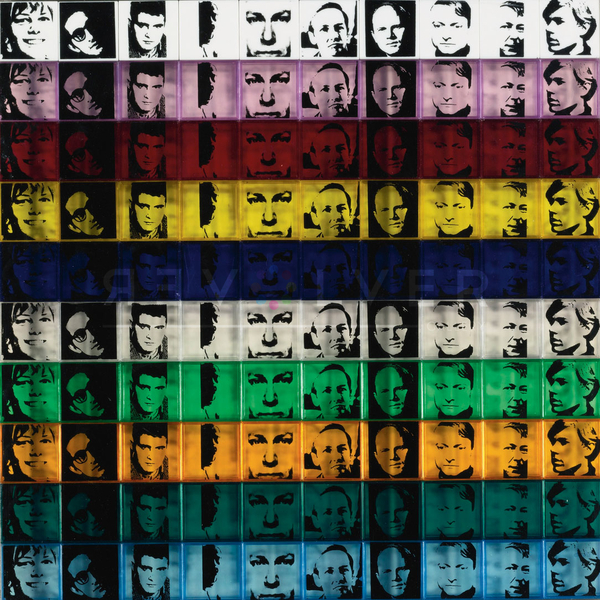
ANDY WARHOL About This Work: Andy Warhol was the most successful and highly paid commercial illustrator in New York even before he began to make art destined for galleries. Neverthless, his screenprinted images of Marilyn Monroe, soup cans, and sensational newspaper stories, quickly became synonymous with Pop Art. Pop Art marked an important new stage in the breakdown between high and low art forms. Warhol’s paintings from the early 1960s were important in pioneering these developments, but it is arguable that the diverse activities of his later years were just as influential in expanding the implications of Pop Art into other spaces, and further eroding the borders between the worlds of high art and popular culture. Andy Warhol is now considered one of the most influential artists of the second half of the 20th century, who created some of the most recognizable images ever produced. Warhol was part of a very exclusive group of artists that the famous and influential New York dealer, Leo Castelli, represented. In 1967 Warhol created Portraits of the Artists, a work that depicts the portraits of 10 artists chosen and represented by Castelli. Sticking with Warhol’s signature style of repetition, he multiplied the artists’ portraits ten times in ten different colors on 3-D polystyrene boxes, each measuring at approximately 2 x 2 inches. The 100 boxes totaled to approximately 20” x 20” when lined up. The artists include Robert Morris, Jasper Johns, Roy Lichtenstein, Larry Poons, James Rosenquist, Frank Stella, Lee Bontecou, Donald Judd, Robert Rauschenberg and Andy Warhol himself. Warhol used the power of the portrait to bring forth the idea of America’s infatuation with celebrity, and the effects of the celebrity in our culture. Pop culture was not only just about Coca Cola bottles, Campbell’s Soup Cans, and Brillo boxes, but also about taking TV, film, music, or literary personalities and exploiting the concept of celebrity. What a better way to pay homage and respect to the most important artists of the time by having Andy Warhol create a work of art that said so much about the artist’s influence on our culture, with just their portraits. No words were needed. The use of repetition is also typical of Andy Warhol. Warhol used silkscreen as his medium of choice. It served as a way to remove the hand of the artist in art, a concept Marcel Duchamp introduced to the art world in the early part of the century. Warhol’s biggest influence in art was Duchamp. Repetition also allowed the artists to further their concepts, by reaching a greater amount of people. Printmaking was the best way to achieve this. By making multiples of a work, more people can own the work, sell the work, and are exposed to the work. It was this marketing that led to Andy Warhol becoming a celebrity himself. |
Tag Archives: popart
WOW – Work Of the Week – Jasper Johns “Two Flags”
 |
||
|
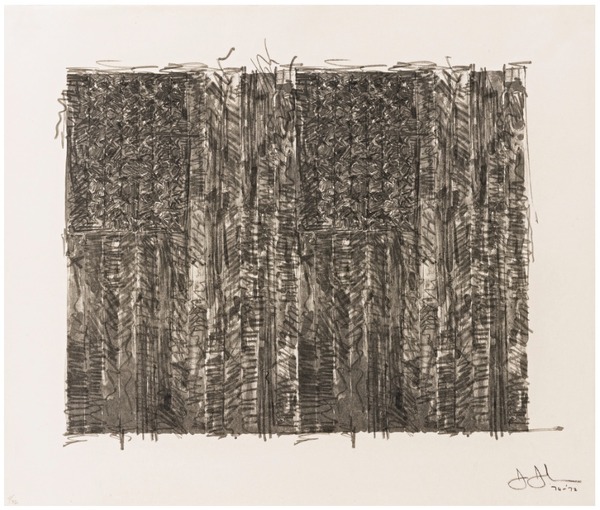
JASPER JOHNS About This Work: “Jasper Johns did not make a painting of the American flag, he made the American flag a painting” – Ron English Jasper Johns was born in 1930 in Georgia, and from an early age, he grew up wanting to be an artist. When in New York City, where he moved to in his twenties, he met the artist and future long-term lover Robert Rauschenberg, choreographer Merce Cunningham, and composer John Cage, all of whom profoundly influenced each other. His career began with a desperate act. At 24, in 1954, two years after he was discharged from the U.S. Army, he destroyed nearly all his art. Then came a kind of vision. “I dreamed I painted a large American flag”. The next morning he began doing just that. His thoughts must have been racing; the enamel house paint he was using wasn’t drying fast enough to capture them. So he switched to wax encaustic. This ancient medium, made of heated beeswax mixed with pigment, dries almost immediately, preserving and showing every brushstroke. This painting was the first of about 100 works that Johns has said were inspired by the dream of the American flag, the painting for which Johns is best known. Jasper Johns’ flag is not just an artwork; it has become one of the most important symbols in the American art. When the first flag was released, critics were unsure whether it was a painted flag or a painting of a flag; Johns later said it was both. For this reason, this work is often described as a piece of Neo-Dadaist and Conceptual art. Due to the playfully subversive appropriation and use of a commonplace icon, it also anticipates aspects of Pop Art. This print, Two Flags, represents two vertical flags and it shows how the artist used to produce flags through variations of not only palette but also position, and repetition, divorcing the flag from its symbolic meaning and focusing on the materials and on the concept.
Initially serving as a means of emphasizing the physical properties of an object by draining it of color and emotions (he often used to say that he liked “to paint with no emotions“), the artist’s employment of gray has evolved into a larger concern. Gray, black, and white exist in Johns’ work not just as colors, but also as ideas and materials. Jasper Johns, indeed, believed the process to be the most important part of making an artwork (This fact led him to experiment with countless media, such as oil, encaustic, ink, pencil, collage and relief, and a prolific career in print making). In November 2014 one of Johns’ encaustic flag paintings was auctioned off for $36,000,000 at Sotheby’s New York.
|
WOW – Work Of the Week – Andy Warhol “Louis Brandeis”
 |
||
|
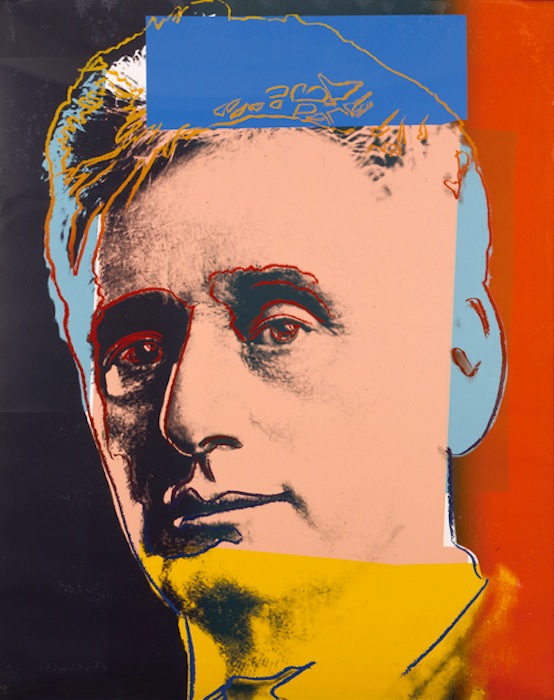
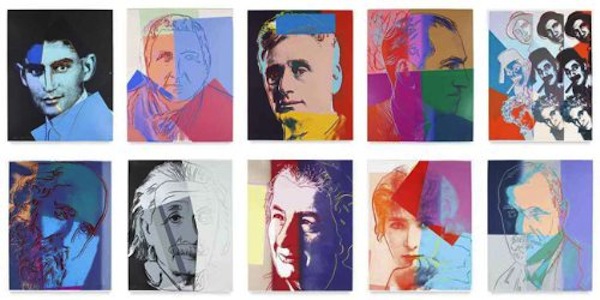
ANDY WARHOL About This Work: In 1980 Andy Warhol produced a suite called Ten Portraits of Jews of the 20th Century. This series appeared at the Jewish Museum that year for the first time. To create this portfolio, Warhol followed his usual procedure for portraits, silk-screening a photograph over previously applied colors and tracing crayon-like lines over the photograph’s contours. The underlying vivid colors are broken up into flat, geometric compositions, creating a mild tension between abstraction and photographic representation. The ten subjects of the series were more than just celebrities. They were all people of great accomplishment. But the real subject in this portraits is Fame. Warhol was obsessed with the concepts of fame and publicity and he was interested in famous people because they were famous. What the series reflects is the distinctively modern experience of knowing many famous people but rarely knowing in any depth what they are famous for. For example, lots of people know the name Gertrude Stein, but how many have actually read anything she wrote? The Ten Portraits Of Jews Of The 20th Century are renowned luminaries of Jewish culture. They are:
The collective achievements of this group changed the course of the twentieth century and may be said to have influenced every aspect of human experience. About Louis Brandeis: Louis Brandeis was an American lawyer. He was born in Louisville, Kentucky, to Jewish immigrant parents. He was the first jewish lawyer to enter the Supreme Court and his work has been fundamental in building some of the most important legal concept of all times, such us the right to privacy, the freedom of speech and the regulation of big corporations and monopolies. Being heavily socially involved and sincerely willing to help people, he used to work for free a lot of times and for this reason he eventually gained the name of “People’s Lawyer”.
|
WOW – Work Of the Week – Lichtenstein “Reflections On Minerva”
 |
||
|
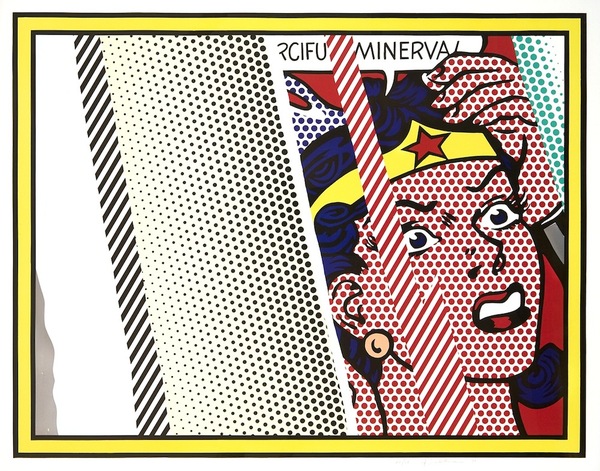
LICHTENSTEIN About This Work: Pop Art draws upon the style and imagery of advertising and popular culture to challenge our preconceptions about the nature of art itself. Roy Lichtenstein not only was a New York Pop Art painter, but also one of the first American Pop artists to achieve widespread notoriety. His very personal and unique style derived from comic strips which portray the trivialization of culture, endemic in contemporary American life. Using bright, strident colors and techniques borrowed from the printing industry, he ironically incorporates mass-produced emotions and objects into highly sophisticated references to art history. This is the case of Reflections On Minerva. Lichtenstein has often explored the theme of Reflections, incorporating them in various paintings and several print series. In 1988 Lichtenstein began working on a group of Reflections paintings, in which the central image is partly obscured by reflective streaks, as if behind glass or reflected in a mirror. Reflections On Minerva can be considered an iconic work, since it is a perfect example of Lichtenstein’s style. A style made of primary colors – red, yellow and blue, heavily outlined in black. Instead of shades of color, he used the ben-day dot, a method by which an image is created, and its density of tone modulated, through the position and size of a myriad of dots during the printing process. The original source for this Reflections print was the November-December 1948 edition of the comic book ‘Wonder Woman’, illustrated by Harry G. Peter. The eponymous super-heroine is shown with a speech bubble exclaiming her catchphrase, ‘Merciful Minerva!’. Wonder Woman regularly invoked the Roman goddess Minerva, who was traditionally known as the goddess of wisdom but also encompassed the arts, trade, poetry, and later, war and power. Despite the title of this work, Reflections On Minerva, the “reflections” are the real protagonists of this work. They are formed by portions of the print striped or dotted and layered upon the image of Minerva, which is drawn with the simple lines typical of comic strips. The theme of reflection is a very important one for Lichtenstein.
Other works by this artist:
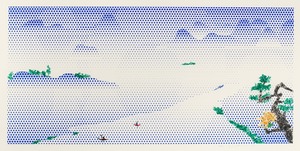 Landscape With Boats 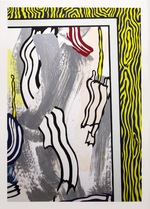 Painting On Blue And Yellow Wall 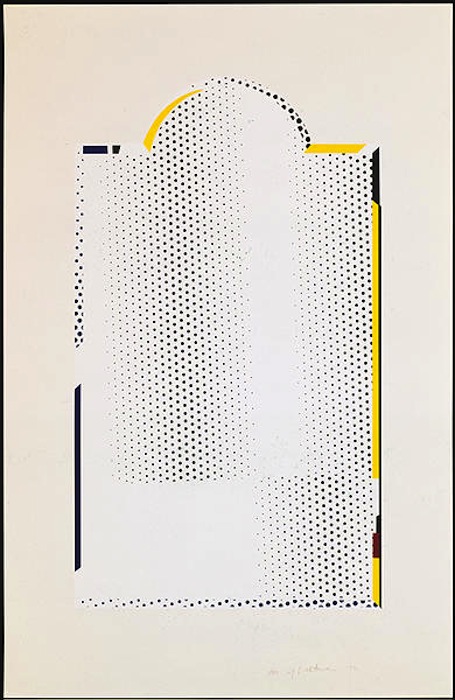 Mirror #7
|
WOW – Work Of the Week – David Hockney “Hat On Chair”
 |
||
|
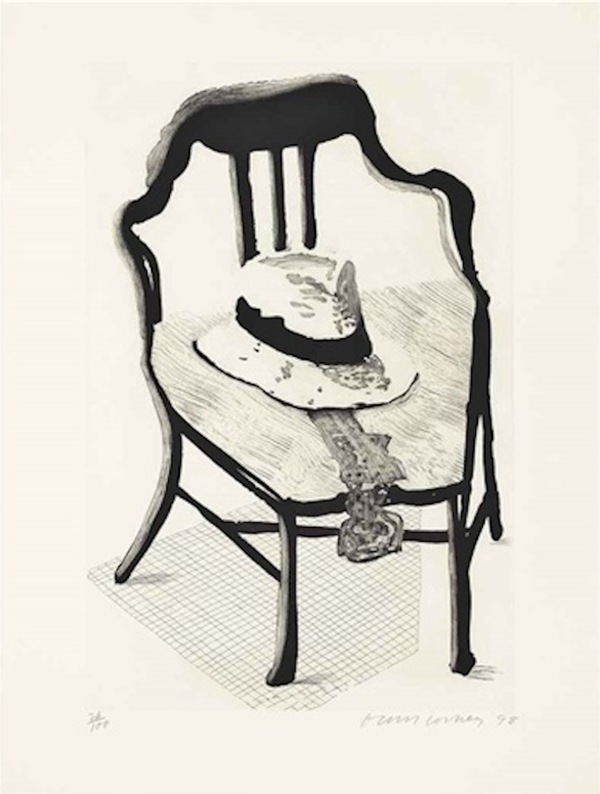
DAVID HOCKNEY About This Work: David Hockney is considered not only an important contributor to the Pop Art movement of the 1960s, but also one of the most influential British artists of the 20th century. During his artistic career, Hockney has produced a wide range of artworks making use of several techniques, but he has always worked on portraits. From 1968, and for the next few years, he painted friends, lovers, and relatives. This is the case of Henry Geldzahler. Henry Geldzahler was the first curator of 20th-century art at the Metropolitan Museum and New York City’s Commissioner of Cultural Affairs. His personal relationships with many of the artists selected for his exhibitions gave him special insight into their works. Andy Warhol himself produced a 90-minute film consisting nothing more than Geldzahler smoking a cigar. His written work focused exclusively on contemporary artists and much of his writing is more criticism than art history. Hockney’s Hat On Chair is one of ten works in the The Geldzahler Portfolio, published in 1998. Other artists that contributed to this portfolio are Jasper Johns, Roy Lichtenstein, James Rosenquist, David Salle, and Frank Stella among others. Dennis Hopper even contributed a photograph of Geldzahler, Warhol, and Hockney smoking. Hockney’s Hat On Chair is one of the most interesting. It is an etching of a Panama hat and bow tie on a chair. Hockney often painted chairs. To Hockney, the Panama hat and bow tie represented the most iconic images Henry Geldzahler, so he preferred to realize such a portrait instead of a “regular” face. In this sense Hockney’s own presence is implied here, since this very personal way to portrait Henry Geldzahler suggests the artist’s unique point of view and sensitivity. |
WOW – Work Of the Week – Lichtenstein “Two Figures With Teepee”
 |
||
|
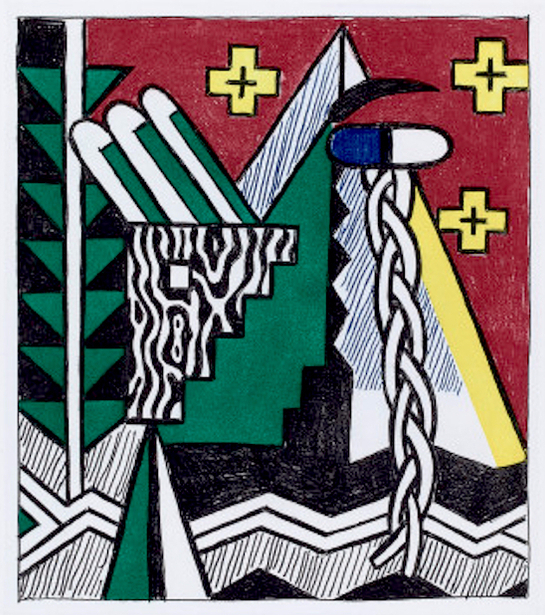
LICHTENSTEIN About This Work: When one thinks of Roy Lichtenstein, one does not think of American Indian Art. However, Lichtenstein was interested in the people of the Old West, particularly Native American Indians. Lichtenstein’s engagement with American Indian art is reflected in two periods: his earliest work and his Surrealist series of the late 1970’s-1980’s. His interest in American Indian art began during the days of his childhood in New York, during several visits to the American Museum of Natural History. In 1950, he began a series of jokey takeoffs on heroic myths and legends. His interest was also partly stimulated by his experiences in Southampton during the late 1970s when he and his wife resided near a Shinnecock Indian reservation, and by the collections of friends such as Jasper Johns, Frank Stella and Donald Judd, all of whom were known to have acquired Native American blankets and other objects to use in their work. Some of the themes that Lichtenstein used in his works are American Indian symbols, specific designs for mythical animals found on pottery and in books, and the hatched lines from Southwestern pottery, textiles and ceramics, just to name a few. Lichtenstein’s Two Figures With Teepee is part of a series of six small intaglios, all of which are soft-ground etching, aquatint and engravings about the American Indian theme. This series was accompanied by another series of six woodcuts, larger in size and different in style. This particular phase of Lichtenstein’s American Indian-inspired work occurred from 1979 to 1981, long after he had established his familiar Pop style. This work has a classic Native American palette formed by saturated reddish-brown, green, yellow and black pigments, with the mold-made Lana paper constituting the rest of the image. The tones refer to the earth and the colors that American Indians use for their textiles and handcrafted items. In Two Figures With Teepee several important elements are present, all recalling the American Indians’ lifestyle and traditions: lightning-like zigzags and crosses symbolizing the four directions, arrow-like triangles, graphic patterns that symbolize wood and leather textures, and a strong component of geometrical abstraction through which the artist reshuffled, stripped and reworked the elements in the flat planes and geometry of Synthetic Cubism. The first figure is formed by a blue eye with and eyebrow and a braid, like the long braids of the American Indian women. The second figure is formed by a squared eye – a type of eye that Lichtenstein often used for this series – and a group of feathers that resembles the typical American Indian headress, almost always decorated with feathers. Both figures make reference to the larger woodcut series. Two Figures With Teepee is formally and iconographically very interesting, a perfect example of the spatial dislocation, proper of the Cubist movement, that unifies all the elements instead of dividing them. Some critics have also stated that the powerfully graphic nature of Native American art most likely appealed to Lichtenstein due to its visual similarity to his own style at this time. Other works by this artist:  Landscape With Boats  Mirror #7  Painting On Blue And Yellow Wall |
WOW – Work Of the Week – Ed Ruscha “Cash For Tools 2”
 |
||||
|
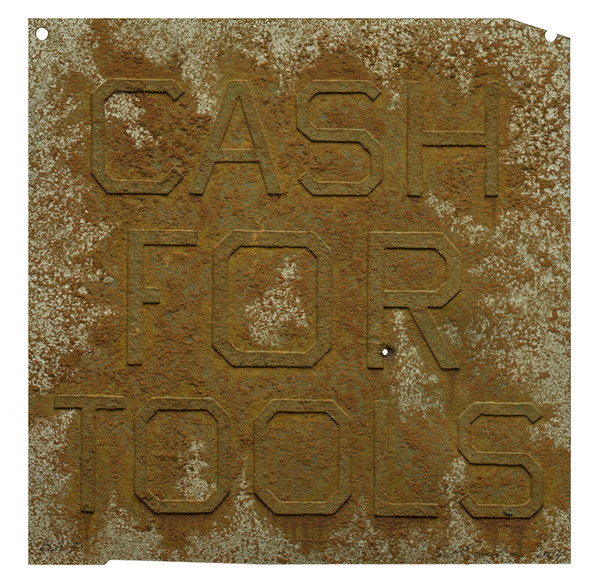
ED RUSCHA About This Work: Ed Ruscha is a well-known American artist who achieved recognition for artworks incorporating words and phrases, all influenced by the deadpan irreverence of the Pop Art movement. Indeed his textual art can be linked with the Pop Art movement but also with the Beat Generation as well. During the Cold War era, the rise of commercial advertising was a dominant force in American life. Consequently, the increasing importance of graphic design, the popularity of Hollywood and American cinema as well as the lights and the landscapes of the West Coast, provided the backdrop against which Ruscha developed his highly original iconography. Since the early sixties, Ed Ruscha has wittily explored language by channeling words and the act of communication to represent American culture. Language, in particular the written word, has pervaded the visual arts, but no other artist has the command over words as Ruscha. His works are not to be understood as pictures of words, but instead words treated as visual constructs. His idea plays into the very essence of Pop Art. Cash For Tools 2 is part of the Rusty Signs, series in which Ruscha uses words, that he considers as “neglected and forgotten signs from neglected and forgotten landscapes”. These Rusty Signs are reproduced in uncanny detail that blurs the line between the fictitious and the real. This artwork, as well as the whole series, is further expression of a consistent theme that runs throughout his work: the passage of time. We are confronted with the physical effect of time upon them, a blunt reminder of its inescapability, even on steel. Once again filtered through the language of common American objects, these prints appear to be rusted signs that read “DEAD END,” “CASH FOR TOOLS,” and “FOR SALE 17 ACRES.” Ruscha has chosen to produce multiple variations of these signs, giving the impression that they have been weathered by time in varying ways, as if they came from different locations or were subjected to a different set of circumstances. For example there are two versions of Cash For Tools and Cash For Tools 2 is more ruined and consumed than Cash For Tools 1. Some have gunshots and some are missing sections, while others appear to have acquired thick layers of rust and grime. In this way, each piece of the series seems to contain an independent story, their histories having literally formed their present state. The Rusty Signs series also marks a transformation of some of Ruscha’s aesthetic concerns; having painted and photographed signs and signage throughout his career, works such as Cash For Tools 2 signify the first time in which he is not merely representing the image of the sign, but actually recreating the sign itself. We no longer see a fictionalized representation but we actually see the sign itself, and its physicality is a part of its essence. At the same time, having been removed from context, they still share the sense of disconnection that permeates in many of his depictions of signs. Ruscha asks us to consider these components of visual culture as independent objects, as if their introduction into the world was not merely an accident or result of inevitable forces, but an act of creation, a work of art. Other works by this artist:
|
||||

WOW – Work Of the Week – Indiana “Love Cross”
 |
||
|
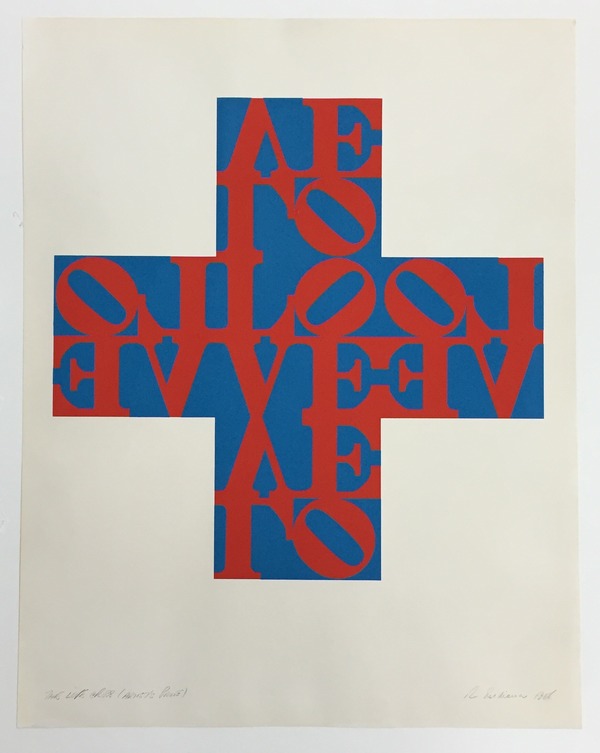
ROBERT INDIANA About This Work: With his calculated use of specific words and numbers – the elements on which most of his work is based on, Robert Indiana’s art is often very complex, introspective, intellectual and cerebral. Indiana captures the complexity of life in the enigmatic intricacies of his compositions. He is a Pop artist but, from this particular point of view, he can also be considered fully conceptual for his hermetic style, which represents a little more than a way stop from the “lack of message and superficiality” of the Pop Art movement. Although the complexity of the meaning and the aesthetic of his work is simple and timeless, mathematics or geometry are the most important elements of inspiration both for his work and his life. Indiana’s art seems to state that his reasons and themes can not be contested, since he bases his work on such logical and unbiased elements. When talking about the aspect of the works, we can not ignore the role that colors play in his compositions. They vibrate to attract each other into a reconciliation of opposite forces. Indiana likes to create endless variations of his works and early themes, experimenting with different color schemes and compositional formats to achieve a wide range of visual and emotional effects. Bright colors, often basic and primary, and the use of words, make his artworks almost monotonous to the eye, but there is plenty of significance underneath. The beauty of Indiana’s is the beauty of taking one’s time to quietly look at something that is not new, but just part of someone’s daily life. It is the beauty of balance and harmony, contemplation and knowledge, the beauty of pure reflections translated in conceptual images. Robert Indiana’s Love Cross embodies all these concepts and features. His choice of the word “Love” recalls his memories of the motto “God is Love“, that he saw emblazoned on the Christian Science church of his youth. Containing both a universal meaning and a visually concise quality, “LOVE” provides him with the perfect synthesis of word and image. The Love Cross was made as an announcement for Indiana’s first one-man museum show at the Institute of Contemporary Art in Philadelphia, the City of Brotherly Love. The theme of Love has achieved recognition as universally familiar as the star and the cross (other two recurring elements in Indiana’s work), eventually becoming the most famous artwork by Indiana who, for this reason, has even been called “the man who invented Love“. This work reflects the artist’s involvement with the formal concerns of the Sixties abstraction, like the use of large areas of pure color, visual power of optical effects, serialization and consciousness of the edge. Indiana’s long-standing involvement with sculptural forms is clear in this cross-shaped work. A cross that is also, not by chance, symmetrical. Furthermore, since the square was his favorite symbol and a square is like a cross with extended borders, it is not difficult to imagine that this shape has been choose for a specific stylistic reason. This non-figurative composition is formed by the symbol/word LOVE, reflected in all the directions. The razor-sharp, hard-edge rigid lines help the viewer to focus not only on the red words, but also on the blue spaces between the letters, which create a visual pattern themselves. Indiana captures the complexity of life itself with simple lines, letters or numbers and flat colors. He helps us to decode life by emphasizing the most important things in it – like love. |
WOW! – Work Of the Week – Tom Wesselmann “Blonde Vivienne”
 |
||
|
TOM WESSELMANN About This Work: Considered by many to be a Pop artist, Tom Wesselmann would rather be called an artist of the post-Matisse era. His works recall Matisse, in a contemporary setting. It’s not hard to understand why categorizing Wesselmann is difficult. The use of erotic images against familiar backgrounds in his work, clean lines and the feel of kitsch exemplifies Pop art, but Wesselmann really never felt like his artwork was part of this artistic movement. Many people know Wesselmann for his nudes. He spent his whole life trying to paint and capture the Great American Nude. However, according to him, he was never able to achieve his goal. He started the Great American Nude series in 1961, where the nude becomes a depersonalized sex symbol set in a commonplace environment. As we can see by Blonde Vivienne, he emphasizes the woman’s hair, mouth neck collar and nipples of her breast, while the rest of the body is usually depicted in flat, unmodulated color or – this is the case – as an empty or negative space. The background is painted in the positive, supplies context and accentuates the negative. There are many different nudes by this artist but they all have one thing in common: when Wesselmann depicts a nude he is not clearly and loudly representing a subject, but he is alluding to and “sketching” a situation, a little gesture or a moment in time. The artist wants us to read into the situation and draw a conclusion for ourselves. Is the Blonde Vivienne sleeping? Is she feeling some kind of pleasure or is she just resting on the couch? The observer is free to choose a personal interpretation of the subject. This also may be the reason why he was so interested in the spaces in and around his drawings. He shifts the focus and scale of the standing objects around a nude; these objects are relatively small in relation to the nude, but sometimes they become major, even dominant elements. To add more mystery, every work is also painted at a particular and/or an unusual angle or point of view. By focusing on the situation, the angle and the details of the background, the viewer is able to imagine what the subject is going through or feeling. For example, in this particular work the viewer is looking at the Blonde Vivienne through a peephole, giving us a sort of voyeuristic point of view. Thus, Blonde Vivienne is a perfect example of showcasing the complexities of a Wesselmann painting. Pop elements occupying space in the positive giving focus to a Matisse like, modern day Odalisque in the negative, captured at a particular view or moment in time, causing the viewer to put it all into one context that he or she can envision for themselves. For more information and price please contact the gallery at info@gsfineart.com |
WOW! – Work Of the Week – Claes Oldenburg “Typewriter Eraser”
 |
||
|
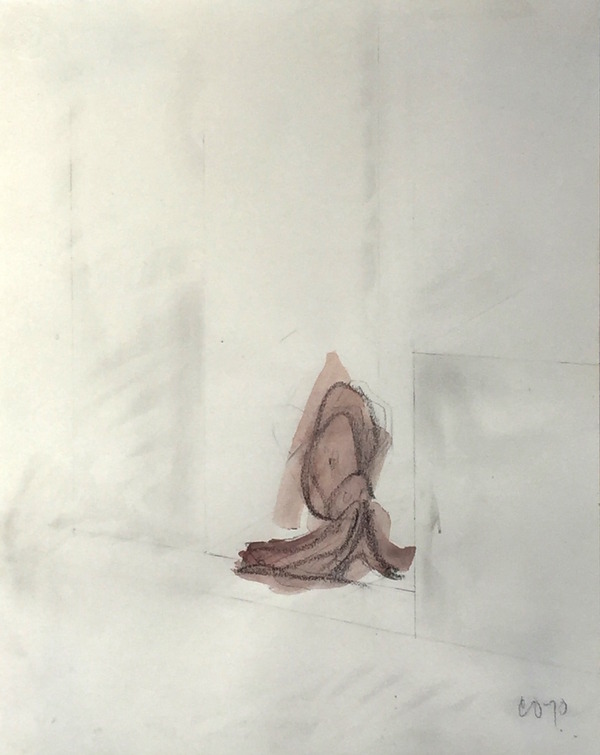
CLAES OLDENBURG About This Work: Claes Oldenburg is an American sculptor, best known for his public art installations typically featuring very large replicas of everyday objects. This beautiful drawing represents a typewriter eraser, a recurring object in Oldenburg’s work. Why a typewriter eraser? Many of Oldenburg’s works depict mundane objects and, at first, they were ridiculed before being accepted by the art world – but they were also defined “brilliant”, due to the reaction that the pop artist brought to a “dull” abstract expressionist period. Oldenburg creates a distinctive order of objects. First, they are things made and utilized by human beings. Used, out-of-date or simply banal, they look rescued from oblivion by the artist. Isolated in a landscape or interior space and inflated in size, they are vulnerable giants. But they are not actual objects elevated to the status of art in the Duchampian tradition of the readymade. While recreating objects, Oldenburg alters their specifics, transforming them through changes in material, scale, context and exaggerations of forms that lend them more than one identity. A typewriter becomes also a tornado. When turned up right we see the eraser rolling towards us with the whiskers rustling in the air resembling a tornado. In this particular drawing of the typewriter eraser we see the subject in motion sweeping down the street like a tornado. Drawings like this are rare “little gems”, hard to find and representative of the soul of Oldenburg’s objects. Oldenburg’s drawings are continuous files of ideas from which major themes have developed. Drawings that he devotes to sculptural projects, imagined or real, appear as “proposals”. These drawings have an anecdotal character in cases where the sculpture is placed in new contexts. They chronicle the further adventures of a subject and track the creative and artistic process of this great artist. This drawing can be considered a generative tool for the large scale Typewriter Eraser, Scale X, constructed in 1999 and now located at the National Gallery Of Art Sculpture Garden, in Washington D.C. |