
 |
||
|
ALEXANDER CALDER About This Work: Alexander Calder (1898 – 1976) is one of the most celebrated artists of the 20th century. Subsequently, upon moving to Paris in 1926, Calder began creating large-scale mechanical installations of intricate circus scenes, featuring wire sculptures with moving parts that he would operate over a two-hour performance session. Building off of his so-called Cirque Calder, he began sculpting portraits and figures out of wire, and received critical attention, exhibiting these works in gallery shows in New York, Paris, and Berlin. While in Paris, he befriended several important Abstract artists, including Joan Miró and Piet Mondrian, and was invited to join the group Abstraction-Création in 1931. Many of Calder’s works on paper and his printwork are studies, tests and theories about his sculptures. As Calder’s sculptures moved into the realm of pure abstraction in the early 1930s, so did his works on paper and prints. The thin lines used to define figures in the earlier prints and drawings began delineating groups of geometric shapes, often in motion. This work from the portfolio Our Unfinished Revolution, is a two-dimensional insight into Calder’s three-dimensional world. Alexander Calder has had several retrospectives, and, among many other awards, was honored with the Presidential Medal of Freedom and the Bicentennial Artist Award from the Whitney Museum of American Art in New York City in 1976. The Guggenheim Museum showed a retrospective of his work in 1964. |
Tag Archives: miamibeach
WOW – Work Of the Week – Robert Indiana “American Dream #5”
 |
||
|
ROBERT INDIANA About This Work: “Among the rain Robert Indiana is one of the original 6 American Pop artists who, back in the 1970s, literally changed the world of art. Subsequently, he moved to Vinalhaven, a place that has acquired an allure of almost mystical isolation, throughout the years. Here Indiana has retired from the world since 1978, although still actively working and producing art. In 1964, when he was still living in New York City, Indiana moved from his first place, a building called Coenties Slip, to a five-story building in the Bowery. In 1969, he began renting the upstairs of a building called “The Star of Hope”, in the island town of Vinalhaven, Maine, as a seasonal studio, from the photographer Eliot Elisofon. This place was wider and very functional for his big works. Half a century earlier, Marsden Hartley, the main source of inspiration for Indiana’s Hartley Elegies suite, had made his escape to the same island. When Elisofon died, Indiana moved in full-time. Indiana’s work often consists of bold, simple, iconic images, especially numbers and short words. His best known example is LOVE, used in countless paintings, prints and sculptures. American Dream #5 is not only referring specifically – through its title – to another painting by another major American painter, Charles Demuth, but it is also a pictorial hymn to a poem by William Carlos Williams, that inspired Demuth himself. Charles Demuth painted a work titled I Saw The Figure 5 In Gold, inspired by Williams’ poem The Great Figure. The poet, in turn, was inspired by seeing a fire truck passing down the street at full speed, with a big gold silhouette of a 5 on the background. One can clearly see the shades of gray that make stand out the other bright and strong colors. The geometrical shapes of stars and circles, and the progressive size of the figure 5, create an optical illusion of movement and speed, making the figure 5 pop and vibrate off the paper as the view stares at it. This chain of poetical and pictorial allusions is enriched in this work by a whole other chain of references to birth or death dates that form a web of intricate numerological references based on various coincidences: Demuth’s painting is dated 1928 – also the year of Indiana’s birth. Indiana’s painting is dated 1963 – also the year of Carlos Williams’ death. The succession of rows of three 5s suggests the figure 35: Demuth died in 1935. This succession of 5s is also describing the sudden progression of the firetruck in the poet’s experience. American Dream #5 itself is composed like a poem, and its cruciform shape remains Indiana’s unmistakable mark. The monosyllabic words like EAT, HUG, ERR, DIE, also belong to Indiana’s own poetry. Again, here autobiography occupies an important role as well: EAT & DIE refer to his mother’s last word before she died. American Dream #5 is Indiana’s most impressive and important work. The poetical, numerological, biographical associations embedded in this work make this jazzy though straightforward artwork one of the most complex works of Indiana’s career and in American Pop art. |
WOW – Work Of the Week – Andy Warhol “Portraits Of The Artists”
 |
||
|
ANDY WARHOL About This Work: Andy Warhol was the most successful and highly paid commercial illustrator in New York even before he began to make art destined for galleries. Neverthless, his screenprinted images of Marilyn Monroe, soup cans, and sensational newspaper stories, quickly became synonymous with Pop Art. Pop Art marked an important new stage in the breakdown between high and low art forms. Warhol’s paintings from the early 1960s were important in pioneering these developments, but it is arguable that the diverse activities of his later years were just as influential in expanding the implications of Pop Art into other spaces, and further eroding the borders between the worlds of high art and popular culture. Andy Warhol is now considered one of the most influential artists of the second half of the 20th century, who created some of the most recognizable images ever produced. Warhol was part of a very exclusive group of artists that the famous and influential New York dealer, Leo Castelli, represented. In 1967 Warhol created Portraits of the Artists, a work that depicts the portraits of 10 artists chosen and represented by Castelli. Sticking with Warhol’s signature style of repetition, he multiplied the artists’ portraits ten times in ten different colors on 3-D polystyrene boxes, each measuring at approximately 2 x 2 inches. The 100 boxes totaled to approximately 20” x 20” when lined up. The artists include Robert Morris, Jasper Johns, Roy Lichtenstein, Larry Poons, James Rosenquist, Frank Stella, Lee Bontecou, Donald Judd, Robert Rauschenberg and Andy Warhol himself. Warhol used the power of the portrait to bring forth the idea of America’s infatuation with celebrity, and the effects of the celebrity in our culture. Pop culture was not only just about Coca Cola bottles, Campbell’s Soup Cans, and Brillo boxes, but also about taking TV, film, music, or literary personalities and exploiting the concept of celebrity. What a better way to pay homage and respect to the most important artists of the time by having Andy Warhol create a work of art that said so much about the artist’s influence on our culture, with just their portraits. No words were needed. The use of repetition is also typical of Andy Warhol. Warhol used silkscreen as his medium of choice. It served as a way to remove the hand of the artist in art, a concept Marcel Duchamp introduced to the art world in the early part of the century. Warhol’s biggest influence in art was Duchamp. Repetition also allowed the artists to further their concepts, by reaching a greater amount of people. Printmaking was the best way to achieve this. By making multiples of a work, more people can own the work, sell the work, and are exposed to the work. It was this marketing that led to Andy Warhol becoming a celebrity himself. |
WOW – Work Of the Week – Jasper Johns “Two Flags”
 |
||
|
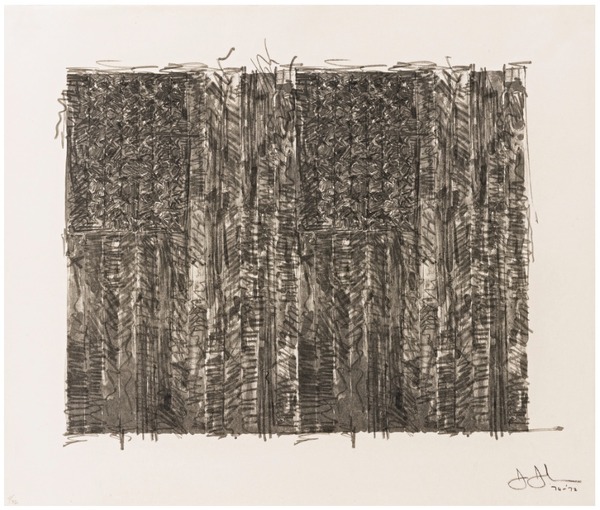
JASPER JOHNS About This Work: “Jasper Johns did not make a painting of the American flag, he made the American flag a painting” – Ron English Jasper Johns was born in 1930 in Georgia, and from an early age, he grew up wanting to be an artist. When in New York City, where he moved to in his twenties, he met the artist and future long-term lover Robert Rauschenberg, choreographer Merce Cunningham, and composer John Cage, all of whom profoundly influenced each other. His career began with a desperate act. At 24, in 1954, two years after he was discharged from the U.S. Army, he destroyed nearly all his art. Then came a kind of vision. “I dreamed I painted a large American flag”. The next morning he began doing just that. His thoughts must have been racing; the enamel house paint he was using wasn’t drying fast enough to capture them. So he switched to wax encaustic. This ancient medium, made of heated beeswax mixed with pigment, dries almost immediately, preserving and showing every brushstroke. This painting was the first of about 100 works that Johns has said were inspired by the dream of the American flag, the painting for which Johns is best known. Jasper Johns’ flag is not just an artwork; it has become one of the most important symbols in the American art. When the first flag was released, critics were unsure whether it was a painted flag or a painting of a flag; Johns later said it was both. For this reason, this work is often described as a piece of Neo-Dadaist and Conceptual art. Due to the playfully subversive appropriation and use of a commonplace icon, it also anticipates aspects of Pop Art. This print, Two Flags, represents two vertical flags and it shows how the artist used to produce flags through variations of not only palette but also position, and repetition, divorcing the flag from its symbolic meaning and focusing on the materials and on the concept.
Initially serving as a means of emphasizing the physical properties of an object by draining it of color and emotions (he often used to say that he liked “to paint with no emotions“), the artist’s employment of gray has evolved into a larger concern. Gray, black, and white exist in Johns’ work not just as colors, but also as ideas and materials. Jasper Johns, indeed, believed the process to be the most important part of making an artwork (This fact led him to experiment with countless media, such as oil, encaustic, ink, pencil, collage and relief, and a prolific career in print making). In November 2014 one of Johns’ encaustic flag paintings was auctioned off for $36,000,000 at Sotheby’s New York.
|
WOW – Work Of the Week – Alex Katz “Julia And Alexandra”
 |
||
| ALEX KATZ Julia And Alexandra 1983 Screenprint 37 x 74 in. Edition of 75 Pencil signed and numbered
About This Work: Alex Katz is an American painter of portraits and landscapes. He started working on these themes during years dominated by non-figurative art, which he always strongly avoided. Alex Katz’s portraits are always very recognizable. They are all characterized by an unmistakable flatness and lack of detail. To represent a shadow or light, he uses slight variations of colors. Many times, monochrome backgrounds represent another defining characteristic of his style. This work, Julia And Alexandra, represents a perfect example of Katz’s style. The flatness and lack of details are juxtaposed by the gradual shading of colors, creating a sense of dimensionality and a conceptual complexity. One important factor that makes his simplistic works more complex is the representation of fashion. It may seem minimal – a couple of lines for a necklace, some polka dots on a scarf – but these details of fashion are most important. As we can see, in this particular work, Julia And Alexandra, Katz not only depicts this portrait in his unique style made of monochromatic colors, flatness and lack of details, but also ties them together with this unifying element of fashion. Despite their apparent simplicity, these details make the faces extremely expressive and perfectly capture the essence of the subjects. It is this element of detail in his work that the artist has always been passionate about. His interest in fashion increased in 1960s, when he began designing sets and costumes for choreographer Paul Taylor as well as theater and dance shows. Costumes, hairstyles, glasses, clothes, shoes, scarves or bathing caps are meticulously considered, as well as the gaze of the subject and his/her position; whether sitting or standing. The genius of Alex Katz’s style is derived directly from one of Katz’s biggest influences, the Master Japanese woodblock artist Kitagawa Utamaro (1753 – 1806). Utamaro’s woodcuts are in the Ukiyo-e tradition, which means “pictures of the floating world” and represent everyday life scenes, capturing a specific person or a particular moment. Utamaro is one of the most highly regarded practitioners of the genre of woodblock prints. He is known for his portraits of beautiful women. This Japanese aesthetic is typically flat and bi-dimensional. He influenced Katz particularly with his use of partial views and his emphasis on light and shade. As with all of Katz’s works, Julia And Alexandra definitely follows along the style and influence of Utamaro’s artworks. Below are a few examples of Utamaro woodblock prints. 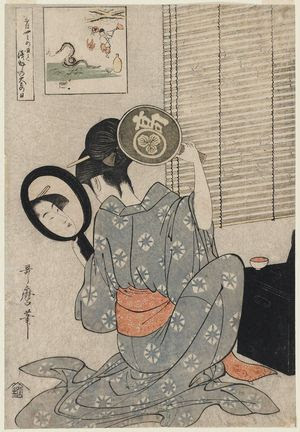 Takashima Ohisa Using Two Mirrors To Observe Her Coiffure  A Beauty After Her Bath
|
WOW – Work Of the Week – Francis Bacon “Study For Bullfight #1”
 |
||
|
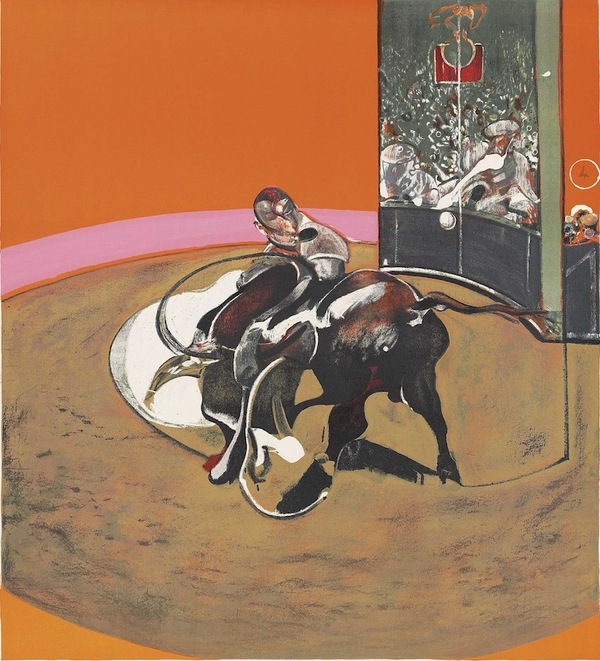
FRANCIS BACON About This Work: This dynamic print by Francis Bacon is based on the first of three bullfight studies that Bacon painted in 1969 following several trips to South of France and Spain. In Study For Bullfight #1, one can see several elements typical of Francis Bacon’s style. One among others, the disfigured head of the bullfighter, which conveys pain and the hectic movement of this cruel fight. Bacon’s great admiration for Picasso’s work, especially the Tauromachie (Guernica), is visible not only in the cubistic style head, but also in the body of the bull, depicted as knot of lines and shadows, in which just one horn, the tail and the bull’s rear legs are recognizable. Bacon frequently contemplates the fragility and suffering of the human condition. Bacon’s Study For Bullfight #1 is a work in which the artist speaks of an unalterable condition of human struggle through the visual allegory of a bullfight. Bacon was actually influenced by the violence and drama of the sport. Francis Bacon was a dominant figure of postwar art, and his artworks remain unmistakable for their contorted emotion and visceral physicality. “I would like my pictures to look as if a human being had passed between them, leaving a sort of human presence” he once said. Click here to see Damien Hirst speaking of Francis Bacon’s work |
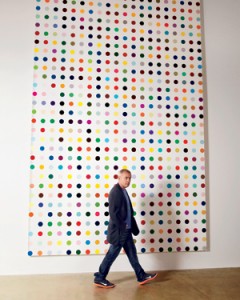
Damien Hirst rejoins Gagosian
Click here or on the picture to read the full article
WOW – Work Of the Week – Andy Warhol “Louis Brandeis”
 |
||
|
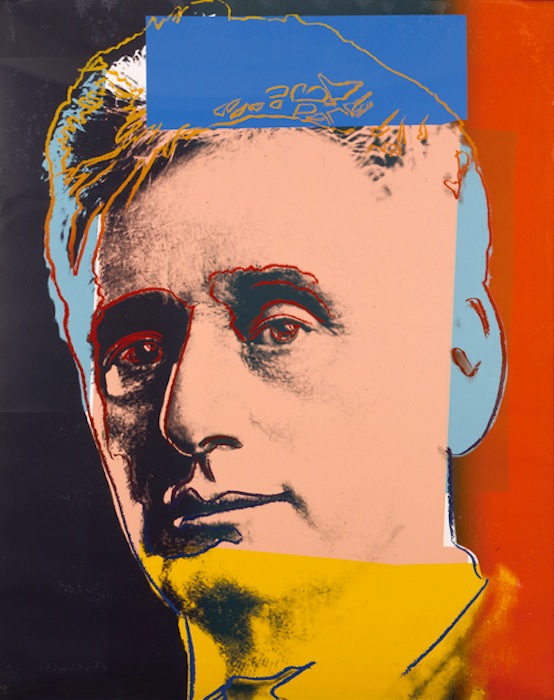
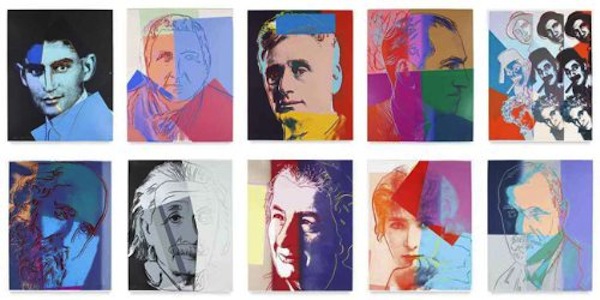
ANDY WARHOL About This Work: In 1980 Andy Warhol produced a suite called Ten Portraits of Jews of the 20th Century. This series appeared at the Jewish Museum that year for the first time. To create this portfolio, Warhol followed his usual procedure for portraits, silk-screening a photograph over previously applied colors and tracing crayon-like lines over the photograph’s contours. The underlying vivid colors are broken up into flat, geometric compositions, creating a mild tension between abstraction and photographic representation. The ten subjects of the series were more than just celebrities. They were all people of great accomplishment. But the real subject in this portraits is Fame. Warhol was obsessed with the concepts of fame and publicity and he was interested in famous people because they were famous. What the series reflects is the distinctively modern experience of knowing many famous people but rarely knowing in any depth what they are famous for. For example, lots of people know the name Gertrude Stein, but how many have actually read anything she wrote? The Ten Portraits Of Jews Of The 20th Century are renowned luminaries of Jewish culture. They are:
The collective achievements of this group changed the course of the twentieth century and may be said to have influenced every aspect of human experience. About Louis Brandeis: Louis Brandeis was an American lawyer. He was born in Louisville, Kentucky, to Jewish immigrant parents. He was the first jewish lawyer to enter the Supreme Court and his work has been fundamental in building some of the most important legal concept of all times, such us the right to privacy, the freedom of speech and the regulation of big corporations and monopolies. Being heavily socially involved and sincerely willing to help people, he used to work for free a lot of times and for this reason he eventually gained the name of “People’s Lawyer”.
|
WOW – Work Of the Week – Joan Miro’ “Barbare Dans La Neige”
 |
|||||
|
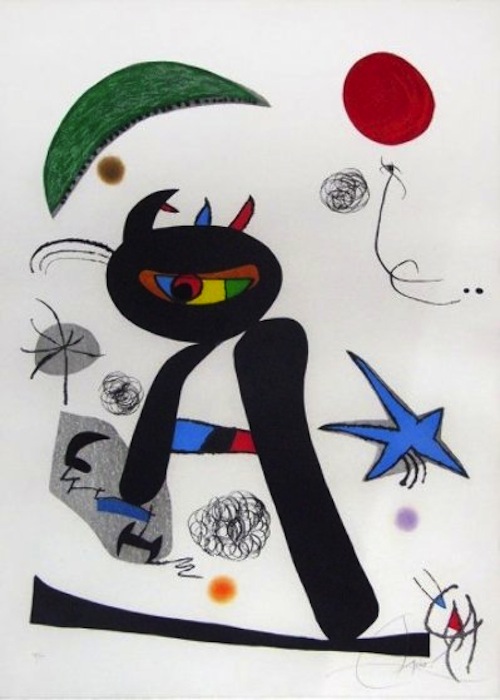
JOAN MIRO’ About This Work: Most people consider Joan Miro’ as being part of the Fauvism, also known as the Naive movement. This artistic movement used a variety of bright colors and looked at the Primitives as artists unaware of the law of harmony and balance and, for this reason, free from any form of artistic constriction. However, Miro’ went through multiple influences during his career. He always gave great importance to shapes, which was common in the Cubism art form, and he was open to the unexpected, like Dadaists and Surrealists. These influences led him to elaborate a very personal concept, a way of looking at Art that eventually became the core of all his artistic work. The concept that representational painting no longer corresponded to artistic truth, nor that the previous artistic movements were able to express adequately the world in which we live, weighted heavily on Miro’. For example to Miro’ war was part of his life and his art. He felt that the current movements of art did not show the effects that World War I and World War II had on the world. For Miro’ to convey his own artistic style and message, he started to research and experiment with many different techniques. Eventually he realized his own identity. Breaking away from the classical thinking and the “rules” that bound his artistic expression, Miro’s technique was a manipulation of reality, in a sense, and its influence is visible in the fragmented and apparently non-organized shapes of this work Barbare Dans La Neige and many others of Miro’s artworks. Barbare Dans La Neige is characterized by the use of pure primary tones with a thick black border, big simple forms and exceptional poetic expression. The artist often worked with a limited palette, yet the colors he used were bold and expressive, emphasizing the potential of fields of unblended color. This whimsical and fanciful subject appears to be quite harmless against the white background and circled by colorful stars, a green crescent moon (a very important element in his iconography) and a bright red accenting mark in the upper margin – maybe a sun. Amorphous amoebic shapes alternate with sharply drawn lines, spots, and curlicues, all positioned on the print seeming nonchalance. This work has a childlike simplicity and playfulness to it, showing how Miro’ sought an essential pictorial vocabulary in primitive sources, particularly prehistoric cave paintings of his native Spain. These painting were formed by signs, symbols and basic linear ingredients. Miro’ invented a new kind of pictorial space in which objects issuing strictly from the artist’s imagination are juxtaposed with basic, recognizable forms. Barbare Dans La Neige is a perfect example of this. |
|||||
WOW – Work Of the Week – Lichtenstein “Reflections On Minerva”
 |
||
|
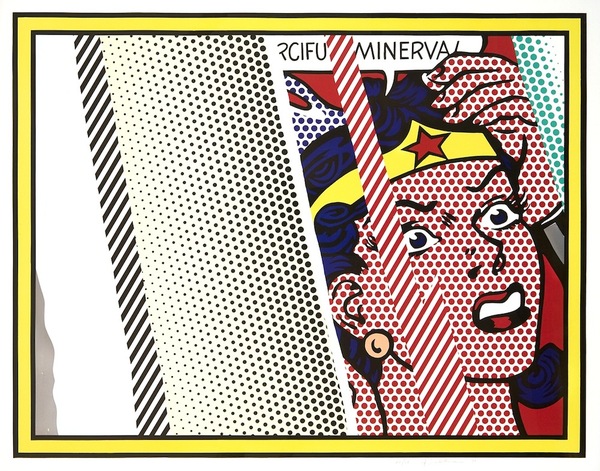
LICHTENSTEIN About This Work: Pop Art draws upon the style and imagery of advertising and popular culture to challenge our preconceptions about the nature of art itself. Roy Lichtenstein not only was a New York Pop Art painter, but also one of the first American Pop artists to achieve widespread notoriety. His very personal and unique style derived from comic strips which portray the trivialization of culture, endemic in contemporary American life. Using bright, strident colors and techniques borrowed from the printing industry, he ironically incorporates mass-produced emotions and objects into highly sophisticated references to art history. This is the case of Reflections On Minerva. Lichtenstein has often explored the theme of Reflections, incorporating them in various paintings and several print series. In 1988 Lichtenstein began working on a group of Reflections paintings, in which the central image is partly obscured by reflective streaks, as if behind glass or reflected in a mirror. Reflections On Minerva can be considered an iconic work, since it is a perfect example of Lichtenstein’s style. A style made of primary colors – red, yellow and blue, heavily outlined in black. Instead of shades of color, he used the ben-day dot, a method by which an image is created, and its density of tone modulated, through the position and size of a myriad of dots during the printing process. The original source for this Reflections print was the November-December 1948 edition of the comic book ‘Wonder Woman’, illustrated by Harry G. Peter. The eponymous super-heroine is shown with a speech bubble exclaiming her catchphrase, ‘Merciful Minerva!’. Wonder Woman regularly invoked the Roman goddess Minerva, who was traditionally known as the goddess of wisdom but also encompassed the arts, trade, poetry, and later, war and power. Despite the title of this work, Reflections On Minerva, the “reflections” are the real protagonists of this work. They are formed by portions of the print striped or dotted and layered upon the image of Minerva, which is drawn with the simple lines typical of comic strips. The theme of reflection is a very important one for Lichtenstein.
Other works by this artist:
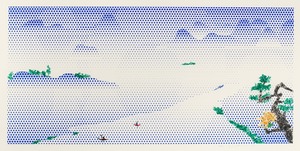 Landscape With Boats 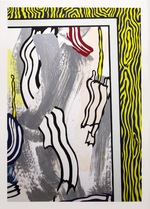 Painting On Blue And Yellow Wall 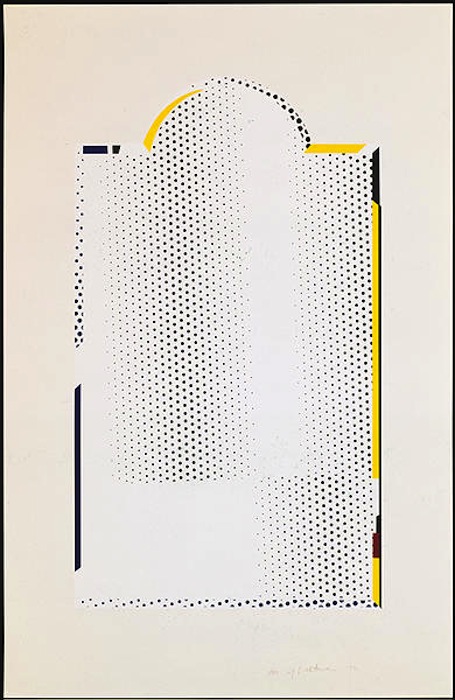 Mirror #7
|