WOW – Work Of the Week – James Rosenquist “Marilyn”

Marilyn stock

James Rosenquist
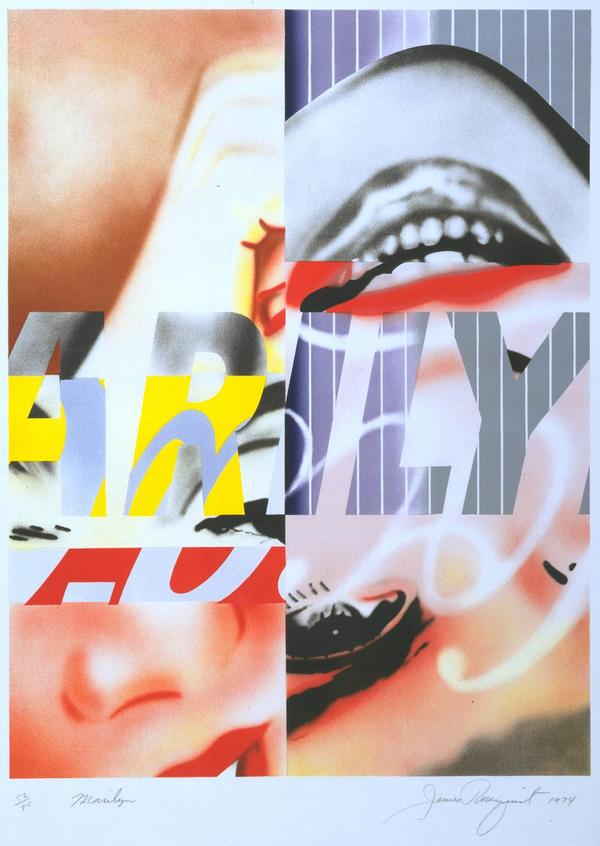
Marilyn
1974
Lithograph
41 3/4 x 29 1/2 in.
Edition of 75

Pencil signed, titled, dated and numbered

About This Work:

With the recent passing of James Rosenquist, Gregg Shienbaum Fine Art is dedicating this week’s Work Of the Week to the icon and pioneer of Pop Art. 

James Rosenquist started his career as a sign painter of commercial billboards, which is often reflected in his large-scale paintings through a flat, uniform, and graphic style. Much of his inspiration was drawn from the advent of large-scale advertising and mass media. The bright hues and precise renderings convey the new, clean, and sterile environments so often used in advertising. However, while on the surface, his works appear to suggest the American Dream of the 1950’s and 1960’s, an underlining message addresses the potential issues American society will confront, and be confronted with, during this emergence of the thriving economy of the postwar.  

One of Mr. Rosenquist’s most famous painting, F-111 is an 86-foot-long commentary on the duality of Americana in 1965 at the height of the Vietnam War. 23 panels juxtaposed a mushroom cloud, a smiling girl, a bomber jet, a beach umbrella, among others. Debuting at the Leo Castelli Gallery in NYC, the piece caused a sensation in the art world. 

Another well-known work is Marilyn Monroe I. Measuring 7’ 9” x 6’ ¼”, this large-scale oil and spray enamel on canvas is a tribute to the sex symbol, created shortly after her sudden death in 1962. Through this work, Rosenquist took upon himself to share with his viewers a more sophisticated message – one that consisted of more than the usual glamourous image of Marilyn Monroe so many artists have utilized. The imagery we are so accustomed to associate with the movie star was transformed, and Rosenquist chose to present her in a manner that denied the immediate recognition, while preserving her coquettishness. One must observe the piece very closely to understand who it is the viewer is confronted with. Monroe’s face is divided into six panes removing her instant recognition, however, Rosenquist demonstrates a unique ability to transmit her spirit. All of Monroe’s features, her eyes, lips and hand, have been fragmented and placed together in an incoherent manner, with bold lettering painted on top in the same disjointed configuration. 

Clearly visible, but also in a fragmented manner, is the Coca-Cola logo, but on closer inspection, overlaying letters of Marilyn Monroe’s name also become apparent. James Rosenquist, being very familiar with the force of branding, mass-production and popular culture, was able to draw attention to the idea that Marilyn Monroe was as important to commercialism and industry as any every day products such as Coca-Cola, drawing upon the message beyond her as a person, but as Marilyn Monroe packaged in the mass media and marketed based on her sex appeal. Rosenquist’s painting of Marilyn Monroe is one of countless others painted by his contemporaries, including Andy Warhol and Willem de Kooning, that attest to the increasing power of mass media and its impact on art production during the 1960’s.

The Marilyn lithograph became available in 1974 and was published by Petersburg Press Inc. in an edition of 75. It is housed in the MoMA and Tate, among many other prominent collections. 

Rosenquist was born in 1933 and passed away in New York City on March 31st 2017 after an illustrious career, which cemented him as one of the most important and influential American artists of our time. 


WOW – Work Of the Week – Robert Rauschenberg “Chow Bags Series”

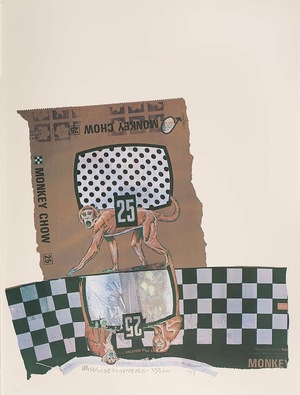
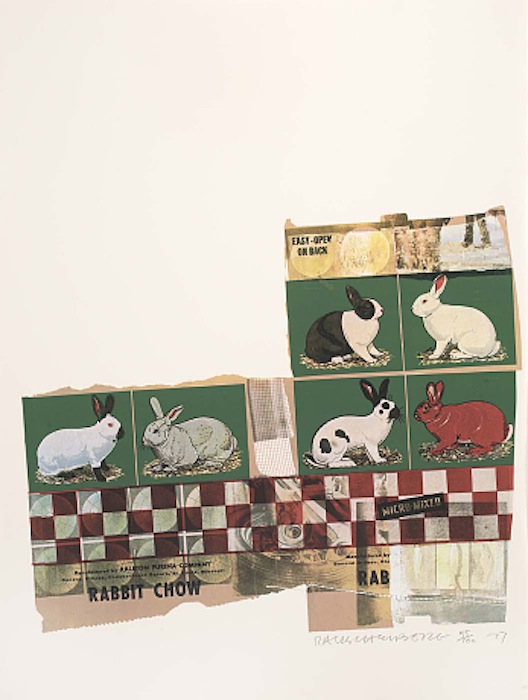
Chow Bags - Monkey Chow Chow Bags - Rabbit Chow

ROBERT RAUSCHENBERG
Monkey Chow and Rabbit Chow, from Chow Bags Series
1977
Screenprint with collage of string
48 1/8 x 36 3/8 in. each
Edition of 100

Pencil signed and numbered

About These Works:

Robert Rauschenberg’s Chow Bags portfolio (1977) consists of six screen prints with graphite and plastic thread, each featuring a different domesticated animal. The prints are based on paper collages that Rauschenberg created from actual bags of animal feed manufactured by Ralston Purina (now Purina Mills), a company best known for its Dog Chow and Cat Chow brands. He chose the packaging for the less common feeds, based on bags for a livestock feed.
They are: 
Mink Chow, Goat Chow, Monkey Chow, Hog Chow, Rabbit Chow, and  Calf Startena (based on a bag for a livestock feed supplemented with nutrients for early growth).

They all share the distinctive red-and-white checkered pattern (except Monkey Chow, which has the green and white checkered pattern), made famous by Purina’s more familiar products. By incorporating this pattern and other prominent design elements of the bags, Rauschenberg’s Chow Bags call attention to the simultaneous familiarity and strangeness of Purina’s graphic identity.

Photographs of the finished collages were used as the basis for the screen prints. Although Rauschenberg selectively cut and partially flattened the paper feed bags to create his collages, he retained their rectangular shape and allowed this form to dictate the overall configuration of each print. The bold, graphic renderings of the animals at the center of these works are surrounded by various arrangements of fainter transfer images such as flowers and leaves, cars stuck in traffic, Coca-Cola bottles, and a woman’s glossy, manicured finger. The resulting compositions present the animals gazing out as in traditional portraiture, playfully framed by colorful graphics and strong geometric shapes. 

After the silkscreen process, additional collage elements were applied to each print, including small pieces of fabric and plastic stitching that mimics the pull-strings used to open feed bags. The Chow Bags series was printed by Styria Studio in New York, and issued in an edition of 100.

Rauschenberg was impressed by the history of Purina Mills. Founded by William Danforth in 1884, the company produced Purina Chow, a line of food for animals that prospered for well over a century. The name of the product has an explanation. The word Purina (from pure) was coined to describe the purity of the grain made by the Danforth mills, and Chow is the name that soldiers during World War I used to refer to food.
Purina Mills supported the United States’ war effort. It assisted farmers through various programs to produce better food for the troops; and during the Great Depression, the company increased the sale of its breakfast products by rewarding — with toys and trinkets — any youngster who returned box tops to the company. This exemplified the power of advertising in even a poor economy. The success and entrepreneurial spirit of the Purina Mills company stands as an example of capitalistic America at it best.

The Chow Bags series embraces the very essence of what Robert Rauschenberg has been trying to capture and convey in his art, and in the Pop Art movement in general.  
Pop Art’s introduction of identifiable imagery (drawn from mass media and popular culture) was a major shift from the direction of Modernism and Abstract Expressionism.   Pop artists celebrated commonplace objects and people of everyday life. By creating paintings or sculptures of mass culture objects and media stars, and incorporating  commercial images, the Pop Art movement aimed to blur the boundaries between “high” art and “low” culture, in this way seeking to elevate popular culture to the level of fine art. 

Rauschenberg’s Chow Bags series seemingly embraced the post World War II manufacturing and media boom. His choice of Purina Chow as imagery is an enthusiastic endorsement of the capitalist market and the goods it circulated, while at the same time denotes an element of cultural critique, playing on the concept of consumerism that was at an all time high after the war, and also elevating the everyday to high art: tying the commodity status of the goods represented to the status of the art objects themselves. Which is exactly what the Pop Art movement is about.

WOW! – Work Of the Week – Tom Wesselmann “Blonde Vivienne”

Blonde Vivienne

TOM WESSELMANN
Blonde Vivienne
1988-89
Screenprint
56 1/4 x 56 3/4 in.
Edition of 100
Pencil signed and numbered


About This Work:

Considered by many to be a Pop artist, Tom Wesselmann would rather be called an artist of the post-Matisse era. His works recall Matisse, in a contemporary setting. It’s not hard to understand why categorizing Wesselmann is difficult. The use of erotic images against familiar backgrounds in his work, clean lines and the feel of kitsch exemplifies Pop art, but Wesselmann really never felt like his artwork was part of this artistic movement.

Many people know Wesselmann for his nudes. He spent his whole life trying to paint and capture the Great American Nude. However, according to him, he was never able to achieve his goal. He started the Great American Nude series in 1961, where the nude becomes a depersonalized sex symbol set in a commonplace environment. As we can see by Blonde Vivienne, he emphasizes the woman’s hair, mouth neck collar and nipples of her breast, while the rest of the body is usually depicted in flat, unmodulated color or – this is the case – as an empty or negative space. The background is painted in the positive, supplies context and accentuates the negative.

There are many different nudes by this artist but they all have one thing in common: when Wesselmann depicts a nude he is not clearly and loudly representing a subject, but he is alluding to and “sketching” a situation, a little gesture or a moment in time. The artist wants us to read into the situation and draw a conclusion for ourselves. Is the Blonde Vivienne sleeping? Is she feeling some kind of pleasure or is she just resting on the couch? The observer is free to choose a personal interpretation of the subject.

This also may be the reason why he was so interested in the spaces in and around his drawings. He shifts the focus and scale of the standing objects around a nude; these objects are relatively small in relation to the nude, but sometimes they become major, even dominant elements.

To add more mystery, every work is also painted at a particular and/or an unusual angle or point of view. By focusing on the situation, the angle and the details of the background, the viewer is able to imagine what the subject is going through or feeling. For example, in this particular work the viewer is looking at the Blonde Vivienne through a peephole, giving us a sort of voyeuristic point of view.

Thus, Blonde Vivienne is a perfect example of showcasing the complexities of a Wesselmann painting. Pop elements occupying space in the positive giving focus to a Matisse like, modern day Odalisque in the negative, captured at a particular view or moment in time, causing the viewer to put it all into one context that he or she can envision for themselves.

For more information and price please contact the gallery at info@gsfineart.com

WOW! – Work Of the Week – Keith Haring “Free South Africa #2”

Keith Haring

Untitled (Free South Africa #2)

1985

Lithograph

32 x 40 in.

Edition of 60

Signed, dated and numbered in pencil

__

ABOUT THIS WORK:

Though many associate the artist Keith Haring with his seemingly innocuous images of barking dogs, crawling babies, beating hearts and flying saucers, his work often tackled social justice issues – from nuclear proliferation, to AIDS, to the environment to racial and income inequality. He was very political and engaged in many of the relevant questions and issues of his time and talked about heavy themes such as racism and apartheid, which Haring tirelessly rallied against— notably printing and distributing 20,000 “Free South Africa” posters in Central Park in 1985.

This work, titled Free South Africa #2, is part of a trilogy which shows us the relationship between black and white people (actually black majority and white minority) in South Africa, during years of repression and inequality, when racial segregation was the rule: it was called “apartheid” (literally “separation”). The black figure in this picture is bigger than the white one, symbolizing the great disparity between the black majority and a few white people that had the power to rule the country during those years. To convey the inequality of the white minority’s powerful grasp on the black majority, the white figure has tied a rope around the black man’s neck. To show hope and signs of defeat, Haring depicts the gigantic black figure, crushing or stomping out this inequality, marked by a red X.  

The figures are placed within the rectangle with Haring’s typical balance and sense of the space, the relationship between the busy and the empty space in the image is tempered, despite of the too different sizes of the figures. The lines stemming from the figures inform us of the movement and the rage of the black man and the worry and inevitable destiny of the white figure, who is about to be crushed.

Using the words of Julia Gruen, a friend of Haring’s and executive director of the Keith Haring Foundation, “…we can feel that image really in the simplest possible way spoke to a kind of political activism. . . It’s really about fighting against oppression. It’s about bucking the system. It’s about questioning authority”.

Haring’s genius was his ability to communicate very directly, very immediately through his chosen symbols and iconography, he could reduce a work to the fewest forms possible to make his point, and racism was an issue that was of paramount concern to Haring. Activism was at the heart of his artistic practice. This is something that is often forgotten or overlooked because the typical whimsical images that have saturated pop culture, and are the ones that are easiest for the masses to consume. However, the joyfulness and a wonderful lightheartedness in his work, is a message of his vision and strong hope of a better world to come.


ABOUT THE ARTIST:

Keith Haring found a thriving alternative art community that was developing outside the gallery and museum system, in the downtown streets, the subways and spaces in clubs and former dance halls. Here he became friends with fellow artists Kenny Scharf and Jean-Michel Basquiat, as well as the musicians, performance artists and graffiti writers that comprised the burgeoning art community. Haring was swept up in the energy and spirit of this scene and began to organize and participate in exhibitions and performances at Club 57 and other alternative venues.

Haring was able to push his own youthful impulses toward a singular kind of graphic expression based on the primacy of the line.

In 1980, Haring found a highly effective medium that allowed him to communicate with the wider audience he desired, when he noticed the unused advertising panels covered with matte black paper in a subway station. He began to create drawings in white chalk upon these blank paper panels throughout the subway system. Between 1980 and 1985, Haring produced hundreds of these public drawings in rapid rhythmic lines, sometimes creating as many as forty “subway drawings” in one day. This seamless flow of images became familiar to New York commuters, who often would stop to engage the artist when they encountered him at work. The subway became, as Haring said, a “laboratory” for working out his ideas and experimenting with his simple lines.

Between 1980 and 1986, Haring achieved international recognition and participated in numerous group and solo exhibitions. His first solo exhibition in New York, held at the Tony Shafrazi Gallery in 1982, was immensely popular and received critical acclaim. During this period, he participated in highly renowned international survey exhibitions such as Documenta 7 in Kassel Germany, the São Paulo Biennial and the Whitney Biennial. Haring completed numerous public projects in the first half of the 80’s.

Throughout his career, Haring devoted much of his time to public works, which often carried social messages. He produced more than 50 public artworks between 1982 and 1989, in dozens of cities around the world, many of which were created for charities, hospitals, children’s day care centers and orphanages

Haring was diagnosed with AIDS in 1988.  Haring enlisted his imagery during the last years of his life to speak about his own illness and generate activism and awareness about AIDS.

During a brief but intense career that spanned the 1980s, Haring’s work was featured in over 100 solo and group exhibitions.  By expressing universal concepts of birth, death, love, sex and war, using a primacy of line and directness of message, Haring was able to attract a wide audience and assure the accessibility and staying power of his imagery, which has become a universally recognized visual language of the 20th century.

Keith Haring died of AIDS related complications at the age of 31 on February 16, 1990.

Since his death, he has been the subject of several international retrospectives. The work of Keith Haring can be seen today in the exhibitions and collections of major museums around the world.