ANDY WARHOL: WITHSTANDING THE TEST OF TIME 3/12/15 – 4/11/15

ANDY WARHOL: WITHSTANDING THE TEST OF TIME

An exhibition of works by Andy Warhol from the 1960s to 1980s on view at Gregg Shienbaum Fine Art

MARCH 12 – APRIL 11, 2015

OPENING RECEPTION     COLLECTOR’S  THURSDAY, MARCH 12, 2015      

6PM-9PM

Andy Warhol        $ (Quadrant) FS II.284        1982

Andy Warhol $ (Quadrant) FS II.284 1982

$ (Quadrant) FS II.284

1982

Screenprint on Lenox Museum Board

40 x 32 in.

Edition of 60. Each print is unique.

This piece is signed and numbered in pencil.


About Andy Warhol:

He was one of the most enigmatic figures in American art. His work became the definitive expression of a culture obsessed with images. He was surrounded by a coterie of beautiful bohemians with names like Viva, Candy Darling, and Ultra Violet. He held endless drug- and sex-filled parties, through which he never stopped working. He single-handedly confounded the distinctions between high and low art. His films are pivotal in the formation of contemporary experimental art and pornography. He spent the final years of his life walking around the posh neighborhoods of New York with a plastic bag full of hundred dollar bills, buying jewelry and knick knacks. His name was Andy Warhol, and he changed the nature of art forever.

Andy Warhol was born Andrew Warhola on August 6, 1928, in Pittsburgh. He received his B.F.A. from the Carnegie Institute of Technology, Pittsburgh, in 1949. That same year, he moved to New York, where he soon became successful as a commercial artist and illustrator. During the 1950s, Warhol’s drawings were published in Glamour and other magazines and displayed in department stores. He became known for his illustrations of I. Miller shoes. In 1952, the Hugo Gallery in New York presented a show of Warhol’s illustrations for Truman Capote’s writings.

During this time, Warhol had also been working on a series of pictures separate from the advertisements and illustrations. It was this work that he considered his serious artistic endeavor. Though the paintings retained much of the style of popular advertising, their motivation was just the opposite. The most famous of the paintings of this time are the thirty-two paintings of Campbell soup cans. With these paintings, and other work that reproduced Coca-Cola bottles, Superman comics, and other immediately recognizable popular images, Warhol was mirroring society’s obsessions. Where the main concern of advertising was to slip into the unconscious and unrecognizably evoke a feeling of desire, Warhol’s work was meant to make the viewer actually stop and look at the images that had become invisible in their familiarity. These ideas were similarly being dealt with by artists such as Jasper Johns, Roy Lichtenstein, and Robert Rauschenberg — and came to be known as Pop Art.

Throughout the late 1950s and 1960s, Warhol produced work at an amazing rate. He embraced a mode of production similar to that taken on by the industries he was mimicking, and referred to his studio as “The Factory.” The Factory was not only a production center for Warhol’s paintings, silk-screens, and sculptures, but also a central point for the fast-paced high life of New York in the ’60s. Warhol’s obsession with fame, youth, and personality drew the most wild and interesting people to The Factory throughout the years. Among the regulars were Mick Jagger, Martha Graham, Lou Reed, and Truman Capote. For many, Warhol was a work of art in himself, reflecting back the basic desires of an consumerist American culture. He saw fame as the pinnacle of modern consumerism and reveled in it the way artists a hundred years before reveled in the western landscape. His oft-repeated statement that “every person will be world-famous for fifteen minutes” was an incredible insight into the growing commodification of everyday life.

By the mid-’60s, Warhol had become one of the most famous artists, in the world. He continued, however, to baffle the critics with his aggressively groundbreaking work. His paintings were primarily concerned with getting the viewer to look at something for longer than they otherwise would.

Throughout the ’70s and ’80s, Warhol produced hundreds of portraits, mostly in silk screen. His images of Liza Minnelli, Jimmy Carter, Albert Einstein, Elizabeth Taylor, and Philip Johnson express a more subtle and expressionistic side of his work.

Following routine gall bladder surgery, Andy Warhol died February 22, 1987. After his burial in Pittsburgh, his friends and associates organized a memorial mass at St. Patrick’s Cathedral in New York that was attended by more than 2,000 people.
WOW! – Work of The Week

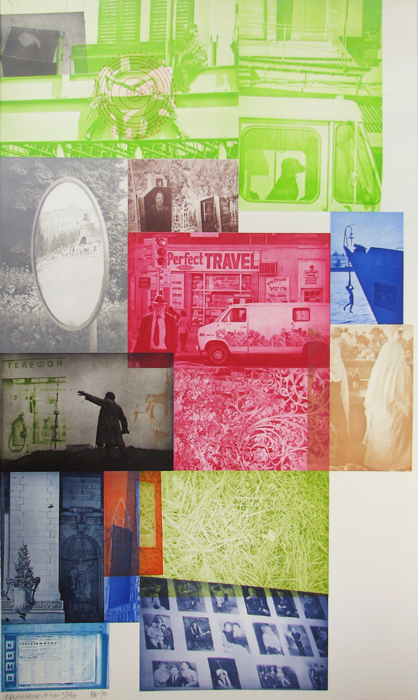
Robert Rauschenberg, Soviet American Array VI

Robert Rauschenberg, Soviet/American Array VI, 1990

Robert Rauschenberg, Soviet/American Array VI, 1990

Robert Rauschenberg
Soviet American Array VI
1990
Intaglio in 16 colors on Saunders paper
88 1/2 x 52 in.
Edition of 59
This piece is pencil signed and numbered.

About This Work:

Rauschenberg’s Soviet American Array VI  is one of a seven print series where he sought to address the politics of newfound peace constructively through his art. In 1989 Rauschenberg became the first American artist since WWII to have a solo show in the Soviet Union. His Moscow show in 1990 debuted his Soviet/American Array series.

The works of the Soviet/American Array series display photographs taken both in the United States and former Soviet Union to highlight the similarities and contrasts of the two major super powers of the Cold War. Rauschenberg juxtaposes photographic subjects that range from street signs to grand Soviet architecture to people immersed in their daily lives and jobs. When put together, these images bring attention to the ways we understand and define cultures, which are both complex and dynamic.


About Robert Rauschenberg:

Robert Rauschenberg began what was to be an artistic revolution. Rauschenberg’s enthusiasm for popular culture and his rejection of the angst and seriousness of the Abstract Expressionists led him to search for a new way of painting. He found his signature mode by embracing materials traditionally outside of the artist’s reach. He would cover a canvas with house paint, or ink the wheel of a car and run it over paper to create a drawing, while demonstrating rigor and concern for formal painting.

By 1958, at the time of his first solo exhibition at the Leo Castelli Gallery, his work had moved from abstract painting to drawings like “Erased De Kooning” (which was exactly as it sounds) to what he termed “combines.” These combines (meant to express both the finding and forming of combinations in three-dimensional collage) cemented his place in art history.

This pioneering altered the course of modern art. The idea of combining and of noticing combinations of objects and images has remained at the core of Rauschenberg’s work.

As Pop Art emerged in the ’60s, Rauschenberg turned away from three-dimensional combines and began to work in two dimensions, using magazine photographs of current events to create silk-screen prints. Rauschenberg transferred prints of familiar images, such as JFK or baseball games, to canvases and overlapped them with painted brushstrokes. They looked like abstractions from a distance, but up close the images related to each other, as if in conversation.

These collages were a way of bringing together the inventiveness of his combines with his love for painting. Using this new method he found he could make a commentary on contemporary society using the very images that helped to create that society.

In 1998 The Guggenheim Museum put on its largest exhibition ever with four hundred works by Rauschenberg, showcasing the breadth and beauty of his work, and its influence over the second half of the century.

WOW! – Work of the Week

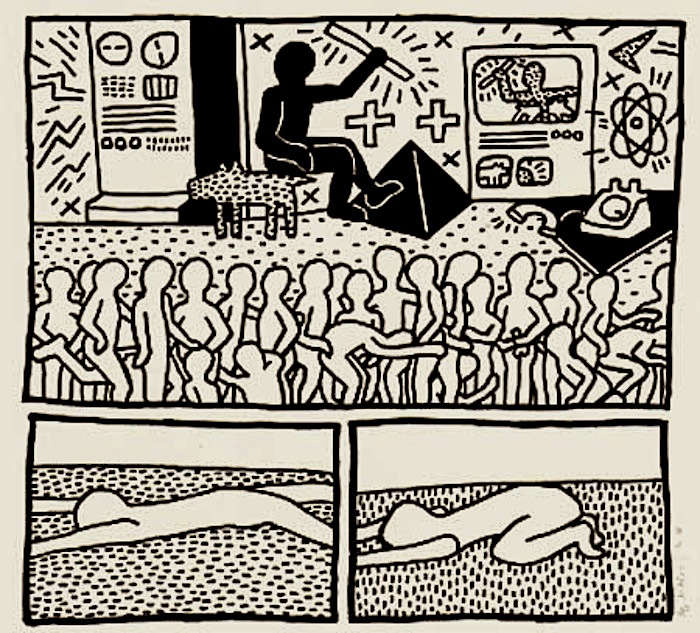
Keith Haring, Blueprint Drawing #15

Keith Haring  Blueprint Drawing #15 1990

Keith Haring Blueprint Drawing #15 1990


Keith Haring
Blueprint Drawing #15
1990
Silkscreen
42 1/2 x 47 in.
Edition of 33

This piece is pencil signed and numbered.

About This Work:

There are many iconic works by Haring, however the Blueprint Drawing series is the more narrative, where he talks about his life, his sexual preferences, how the world was infected and affected by the realization of mortality based on life choice and the alienation that occurred at the time. In a sense, this series was his autobiography and his outlook on the world around him.  Thus, he created this series at the end of his life. It actually is the last series he signed before he passed. There are certain series that artists create where you see and feel them in their work. For Andy Warhol and Jasper Johns, you see the artist in their early works. However for Haring,  you really see him and get a sense of knowing him in his later work. This could be because he was approaching death at such a young age.


About Keith Haring:

Keith Haring found a thriving alternative art community that was developing outside the gallery and museum system, in the downtown streets, the subways and spaces in clubs and former dance halls. Here he became friends with fellow artists Kenny Scharf and Jean-Michel Basquiat, as well as the musicians, performance artists and graffiti writers that comprised the burgeoning art community. Haring was swept up in the energy and spirit of this scene and began to organize and participate in exhibitions and performances at Club 57 and other alternative venues.

Haring was able to push his own youthful impulses toward a singular kind of graphic expression based on the primacy of the line. 

In 1980, Haring found a highly effective medium that allowed him to communicate with the wider audience he desired, when he noticed the unused advertising panels covered with matte black paper in a subway station. He began to create drawings in white chalk upon these blank paper panels throughout the subway system. Between 1980 and 1985, Haring produced hundreds of these public drawings in rapid rhythmic lines, sometimes creating as many as forty “subway drawings” in one day. This seamless flow of images became familiar to New York commuters, who often would stop to engage the artist when they encountered him at work. The subway became, as Haring said, a “laboratory” for working out his ideas and experimenting with his simple lines. 

Between 1980 and 1986, Haring achieved international recognition and participated in numerous group and solo exhibitions. His first solo exhibition in New York, held at the Tony Shafrazi Gallery in 1982, was immensely popular and received critical acclaim. During this period, he participated in highly renowned international survey exhibitions such as Documenta 7 in Kassel Germany, the São Paulo Biennial and the Whitney Biennial. Haring completed numerous public projects in the first half of the 80’s. 

Throughout his career, Haring devoted much of his time to public works, which often carried social messages. He produced more than 50 public artworks between 1982 and 1989, in dozens of cities around the world, many of which were created for charities, hospitals, children’s day care centers and orphanages

Haring was diagnosed with AIDS in 1988.  Haring enlisted his imagery during the last years of his life to speak about his own illness and generate activism and awareness about AIDS. 

During a brief but intense career that spanned the 1980s, Haring’s work was featured in over 100 solo and group exhibitions.  By expressing universal concepts of birth, death, love, sex and war, using a primacy of line and directness of message, Haring was able to attract a wide audience and assure the accessibility and staying power of his imagery, which has become a universally recognized visual language of the 20th century.

Keith Haring died of AIDS related complications at the age of 31 on February 16, 1990. 

Since his death, he has been the subject of several international retrospectives. The work of Keith Haring can be seen today in the exhibitions and collections of major museums around the world.