WOW! – Work of the Week

Keith Haring, Blueprint Drawing #15
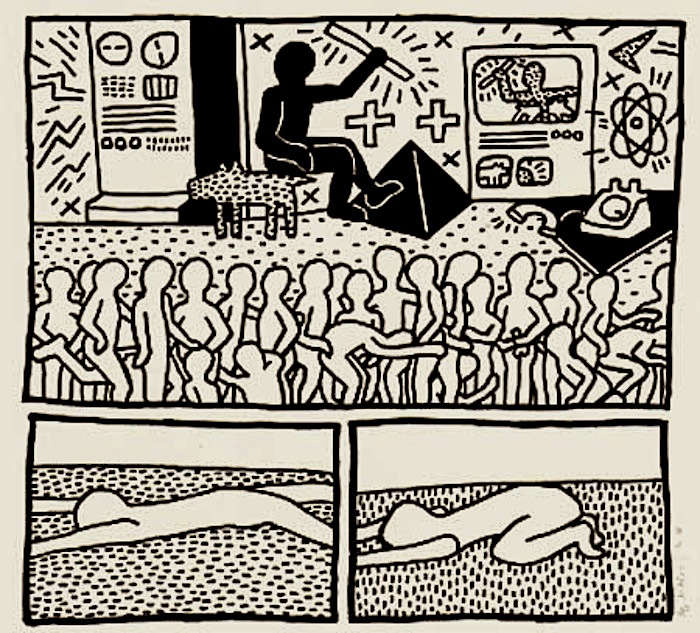
Keith Haring  Blueprint Drawing #15 1990

Keith Haring Blueprint Drawing #15 1990


Keith Haring
Blueprint Drawing #15
1990
Silkscreen
42 1/2 x 47 in.
Edition of 33

This piece is pencil signed and numbered.

About This Work:

There are many iconic works by Haring, however the Blueprint Drawing series is the more narrative, where he talks about his life, his sexual preferences, how the world was infected and affected by the realization of mortality based on life choice and the alienation that occurred at the time. In a sense, this series was his autobiography and his outlook on the world around him.  Thus, he created this series at the end of his life. It actually is the last series he signed before he passed. There are certain series that artists create where you see and feel them in their work. For Andy Warhol and Jasper Johns, you see the artist in their early works. However for Haring,  you really see him and get a sense of knowing him in his later work. This could be because he was approaching death at such a young age.


About Keith Haring:

Keith Haring found a thriving alternative art community that was developing outside the gallery and museum system, in the downtown streets, the subways and spaces in clubs and former dance halls. Here he became friends with fellow artists Kenny Scharf and Jean-Michel Basquiat, as well as the musicians, performance artists and graffiti writers that comprised the burgeoning art community. Haring was swept up in the energy and spirit of this scene and began to organize and participate in exhibitions and performances at Club 57 and other alternative venues.

Haring was able to push his own youthful impulses toward a singular kind of graphic expression based on the primacy of the line. 

In 1980, Haring found a highly effective medium that allowed him to communicate with the wider audience he desired, when he noticed the unused advertising panels covered with matte black paper in a subway station. He began to create drawings in white chalk upon these blank paper panels throughout the subway system. Between 1980 and 1985, Haring produced hundreds of these public drawings in rapid rhythmic lines, sometimes creating as many as forty “subway drawings” in one day. This seamless flow of images became familiar to New York commuters, who often would stop to engage the artist when they encountered him at work. The subway became, as Haring said, a “laboratory” for working out his ideas and experimenting with his simple lines. 

Between 1980 and 1986, Haring achieved international recognition and participated in numerous group and solo exhibitions. His first solo exhibition in New York, held at the Tony Shafrazi Gallery in 1982, was immensely popular and received critical acclaim. During this period, he participated in highly renowned international survey exhibitions such as Documenta 7 in Kassel Germany, the São Paulo Biennial and the Whitney Biennial. Haring completed numerous public projects in the first half of the 80’s. 

Throughout his career, Haring devoted much of his time to public works, which often carried social messages. He produced more than 50 public artworks between 1982 and 1989, in dozens of cities around the world, many of which were created for charities, hospitals, children’s day care centers and orphanages

Haring was diagnosed with AIDS in 1988.  Haring enlisted his imagery during the last years of his life to speak about his own illness and generate activism and awareness about AIDS. 

During a brief but intense career that spanned the 1980s, Haring’s work was featured in over 100 solo and group exhibitions.  By expressing universal concepts of birth, death, love, sex and war, using a primacy of line and directness of message, Haring was able to attract a wide audience and assure the accessibility and staying power of his imagery, which has become a universally recognized visual language of the 20th century.

Keith Haring died of AIDS related complications at the age of 31 on February 16, 1990. 

Since his death, he has been the subject of several international retrospectives. The work of Keith Haring can be seen today in the exhibitions and collections of major museums around the world. 

WOW! – Work of the Week

Alexander Calder, Pinwheel

Alexander Calder     Pinwheel   c.1970

Alexander Calder Pinwheel c.1970

Alexander Calder

Pinwheel

c. 1970

Lithograph

62 x 46 in.

Edition of 30

This piece is pencil signed and numbered.

About This Work:

Alexander Calder is best known for creating mobiles—sculptures composed of abstract shapes moving through spaces. Many of his lithographs can be seen as studies of movement for his mobiles, as well as the capturing of movement for his stabiles — stationary sculptures. Pinwheel is one of the larger prints Calder made to view and chronicle how the shapes would move on the mobile from an anterior view. With the primary colored shapes starting in one place and moving to an alternative axis only when the other shapes were in a particular place in space.


About Alexander Calder:

In a time of constant artistic upheaval, Alexander Calder’s aesthetic revolution concerned itself with a somewhat taboo topic in the art world — fun. His prolific and passionate output brought with it a humor and sense of play unlike any before. From a wire animal the size of a match box to a fountain filled with mercury to a seventy foot representation of a man in metal, Calder ignored the formal structures of art and in so doing redefined what art could be.

Born in 1898 in Philadelphia, Calder came from a family of artists. Both his father and grandfather were well-known sculptors, and his mother was a painter. Throughout his young life, Calder was more interested in mechanics and engineering than art. After graduating high school he attended the Stevens Institute of Technology, receiving his degree in 1919. Within a short while, however, his creative energies turned toward art and he enrolled in the Art Student’s League in New York. Working as a freelance illustrator, Calder began to paint and sculpt. Soon after his first one man show in New York, Calder left for Paris.

It was then that he began work on one of his most famous projects, the “Calder Circus”. The “Circus” was a miniature reproduction of an actual circus. Made from wire, cork, wood, cloth and other easily found materials, the “Circus” was a working display that Calder would show regularly. A mix between a diorama, a child’s toy, and a fair game, Calder’s “Circus” found many eager fans among the avant-garde. One of the methods used to create the “Circus” was the bending of wire to form realistic figures. Drawn to the ease and simplicity of it, Calder began to make wire portraits. A combination of a line drawing and of sculpture, these instant portraits represented a new possibility in three dimensional art.

By the early 1930s Calder had brought his “Circus” to the United States and back, and was living in Paris off the proceeds of his regular performances. While regularly fixing and adding to the “Circus”, Calder began to show and work on wire and wood sculpture as well as painting. It was around this time that he became interested in the work of the Surrealist painter Joan Miró and the modernist painter Piet Mondrian. Both men had gone beyond abstraction and were making paintings of colors and shapes with no direct reference to the outside world. Enthusiastic about this embrace of form and color, Calder began to make moving sculptures in a similar vane.

Beginning with painted aluminum and wire, Calder created motored objects that could move to create different visual effects. In a short while, however, he realized that the mechanized movement didn’t have the fluidity or the surprise he wanted in his work. He decided to let them hang and have the wind or a slight touch begin their movement. When the experimental French artist Marcel Duchamp saw them, he named them “mobiles” (a pun on the French for “to move” and “motive”). These new sculptures, arranged by the chance operations of the wind, went against everything that sculpture had been. They were not monumental, nor were they sober. They were simply about form and color and the joy in creating both. So, in his early thirties Alexander Calder had not only found a project he would continue for the rest of his life, he had created a unique form of art, the mobile.

In 1933, Calder and his wife, Louisa James, moved to Roxbury, Connecticut, where they would spend the rest of their lives. Working on hundreds of small mobiles, Calder became interested in making large, more substantial works as well. Using similar colorful abstract forms, he made giant metal structures whose shapes and colors stood out bravely in both rural and urban settings. Known as “stabiles,” these works often had a similar whimsical quality to the smaller kinetic pieces. By the time of his first major show at the Museum of Modern Art in 1943, Calder’s quiet revolution was known internationally. Throughout the 1940s and 1950s he was commissioned to create site specific “stabiles” and had major retrospectives in a number of cities including Amsterdam, Berne, and Rio de Janiero.

By 1970, Calder had reached the height of his fame. He had worked regularly creating thousands upon thousands of objects—everything from jewelry to children’s toys to major monuments for the Lincoln Center in New York and UNESCO in Paris. That same year his gifts were honored again with a comprehensive show at the Guggenheim Museum and a smaller one at the Museum of Modern Art. In 1976, Alexander Calder died. Throughout his life, his commitment to creating work free from the pretensions of the art world and accessible to all, never stopped him from making exquisitely beautiful and important sculpture. In a century that saw the forms of art and literature reinvented regularly, Alexander Calder stands out as one of the great pioneers of his time.  Adapted from PBS.

WOW! – Work of The Week

Ed Ruscha, Stranger

Ed Ruscha  Stranger  1983

Ed Ruscha,   Stranger,   1983

Ed Ruscha

Stranger

1983

Lithograph

30 x 22 1/2 in.

B.A.T.

This piece is pencil signed and numbered.

About This Work:

Since the early sixties, Ruscha has wittily explored language by channeling words and the act of communication to represent west coast American culture. Language, in particular the written word, has pervaded the visual arts, but no other artist has the command over words as Ruscha. His works are not to be understood as pictures of words, but instead words treated as visual constructs. His idea plays into the very essence of Pop Art.

Ruscha offers the capacity for multiple meanings of words, as seen in Stranger. Stranger can be a understood as a comparison of more or less than, or rather  something or someone unknown. There is no definitive right answer, the meaning is based upon viewer discretion. The descending style in which he displays the word, both iconic and playful, elicits a similar ambiguity.


About Ed Ruscha:

Edward Ruscha has remained an important figure in American art since the early 1960s when his artwork first came to the fore as part of the West Coast Pop Art movement. Since that time, he has continued to develop his signature style, which combines words and images on the same visual field.  By doing so, visual and verbal means of communication coexist and create a sense of friction. The words conjure mental images that do not necessarily describe what the eye actually sees in the painting.

A painter, printmaker, and filmmaker, Edward Ruscha was born in Omaha, Nebraska, in 1937, and lived some 15 years in Oklahoma City before moving permanently to Los Angeles where he studied at the Chouinard Art Institute from 1956 through 1960. By the early sixties he was well known for his paintings, collages, and printmaking, and for his association with the Ferus Gallery group, which also included artists Robert Irwin, Edward Moses, Ken Price, and Edward Kienholz. He later achieved recognition for his paintings incorporating words and phrases and for his many photographic books, all influenced by the deadpan irreverence of the Pop Art movement.

Ruscha has a talent for making the banal seem significant. He often reduces his subject to the minimum amount of detail needed for identification. Places and structures are often depicted as shadows. Ruscha is interested in language, and how that language can describe but not depict space. Words have been present in many of Ruscha’s paintings, often occupying the whole canvas. What they say is always clear. What they mean is more ambiguous

A major retrospective of Ruscha’s career opened at the Hirshhorn Museum and Sculpture Garden in Washington, D.C. in June 2000 and traveled to the Museum of Contemporary Art, Chicago, The Miami Art Museum, and the Modern Art Museum of Ft. Worth, TX. In 2001 Ruscha was elected to The American Academy of Arts and Letters as a member of the Department of Art.

Ruscha’s work has been exhibited internationally for three decades and is represented in major museum collections. Among his other public commissions are a mural commissioned for the Miami-Dade Public Library, Miami, Florida (1985 and 1989); and for the Great Hall of the Denver Central Library, Colorado (1994-95). Ruscha is represented in Los Angeles by Gagosian Gallery and in New York by Leo Castelli Gallery.   

In 2004, The Whitney Museum of American Art exhibited an Ed Ruscha drawing retrospective, “Cotton Puffs, Q-tips®, Smoke and Mirrors: The Drawings of Ed Ruscha,”.   

At the invitation of the U.S Department of State, four distinguished American museums recommended noted American artist Ed Ruscha to represent the United States at the 2005 Venice Biennale. The group consisted of the directors and curatorial representatives of the Solomon R. Guggenheim Museum, the Hirshhorn Museum and Sculpture Garden of the Smithsonian Institution, the San Francisco Museum of Modern Art and the Whitney Museum of American Art.  Mr. Ruscha nominated Linda Norden, the Associate Curator of Contemporary Art at the Fogg Art Museum of Harvard University, to serve as curator of his exhibition.  The U.S. Department of State approved these recommendations.